








Smart Fiber from Rice Bran
Research news
Sep 14, 2026
Author: nutthawat.s@cmu.ac.th
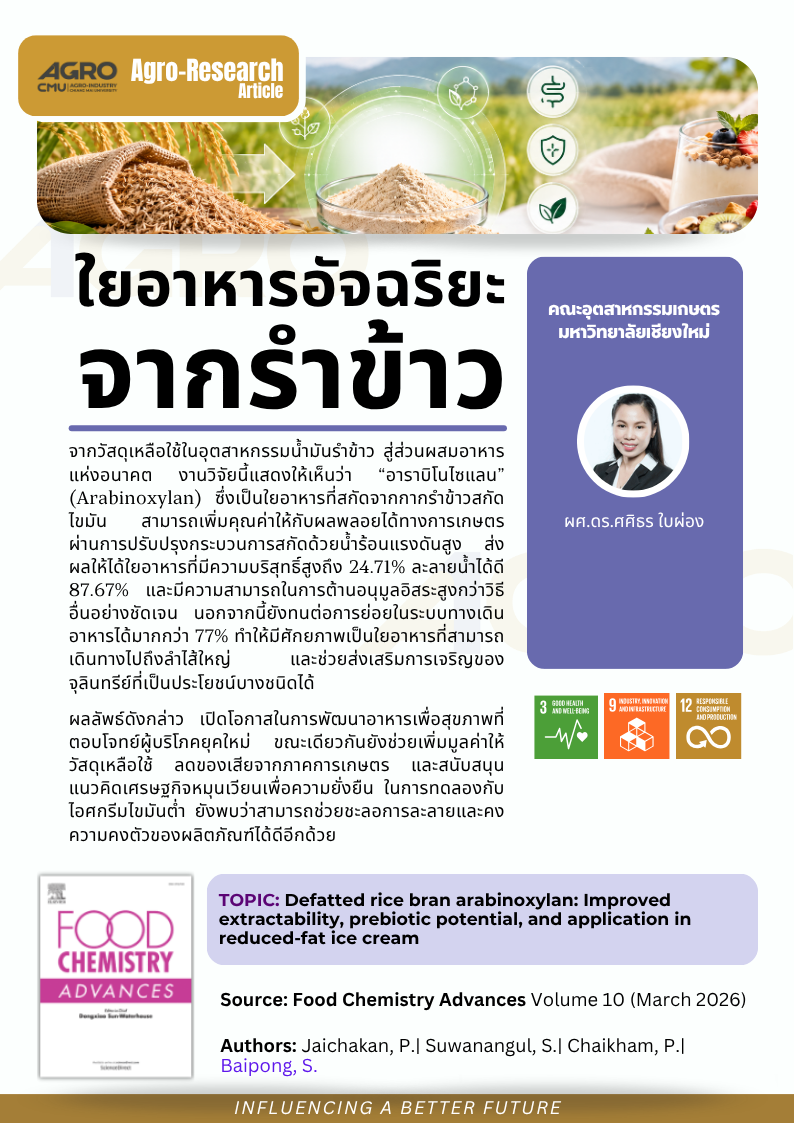
Turning agricultural by-products into value-added food ingredients, this study demonstrates the potential of arabinoxylan, a dietary fiber extracted from defatted rice bran, as a next-generation functional ingredient. By applying hydrothermal pretreatment, researchers obtained arabinoxylan with a purity of 24.71%, high water solubility of 87.67%, and enhanced antioxidant activity compared with other extraction approaches. The fiber also showed strong resistance to digestion, with more than 77% remaining intact through simulated gastrointestinal conditions, indicating its potential to reach the colon and support the growth of beneficial gut bacteria. Beyond human health benefits, the innovation contributes to the sustainable utilization of rice-processing by-products, helping reduce agricultural waste and promote a circular economy. When incorporated into reduced-fat ice cream, the ingredient improved melting stability while maintaining product quality, highlighting its promise for healthier and more sustainable food products.
Topic: Defatted rice bran arabinoxylan: Improved extractability, prebiotic potential, and application in reduced-fat ice cream
Authors: Jaichakan, P.| Suwanangul, S.| Chaikham, P.| Baipong, S.
Abstract:
This study aimed to improve arabinoxylan (AX) extractability from defatted rice bran (DFRB) using hydrothermal, acid, and enzymatic pretreatments prior to alkaline extraction, followed by evaluation of their physicochemical, in vitro prebiotic, and specific application properties, including solubility, color characteristics, antioxidant activity, in vitro digestibility, bacterial growth responses, and functional performance in reduced-fat ice cream (overrun and melting stability). Hydrothermal pretreatment produced AX with the highest purity (24.71 %), solubility (87.67 %), and antioxidant activity (6.19 mg TE/g), along with improved lightness compared with untreated, acid-treated, and enzymatically treated fractions. In vitro digestion confirmed that hydrothermally pretreated AX (H-AX) resisted hydrolysis (< 23 %), supporting its classification as a non-digestible dietary fiber. H-AX selectively stimulated Lactobacillus casei and Lactobacillus sake, providing preliminary in vitro evidence of fermentability rather than confirmed in vivo prebiotic efficacy. Incorporation of H-AX into reduced-fat ice cream maintained overrun and reduced melting rate, enhancing stability. While AX imparted darker coloration, this trait could benefit darker-flavored products. Overall, hydrothermal pretreatment was the most effective strategy under the conditions examined in this study to enhance AX recovery and functionality, although long-term stability, process economics, and industrial scalability were not evaluated. The findings demonstrate a sustainable approach to valorize DFRB into multifunctional food ingredients with dual in vitro prebiotic and techno-functional potential, while highlighting the need for further in vivo validation before physiological benefits can be claimed.
Source: Food Chemistry Advances Volume 10 (March 2026)
Keywords: Defatted rice bran; Arabinoxylan; Prebiotic properties; Techno-functional ingredients; Hydrothermal pretreatment
View at publisher: https://www.sciencedirect.com/science/article/pii/S2772753X26000341
Recent News
- Research newsSep 14, 2026
 Faculty activitiesSep 9, 2026