







Potential of Selenopeptides Derived from Wolffia globosa in Enhancing Cellular Protection and Inhibiting Cancer Cell Proliferation
Research news
Apr 16, 2026
Author: nutthawat.s@cmu.ac.th
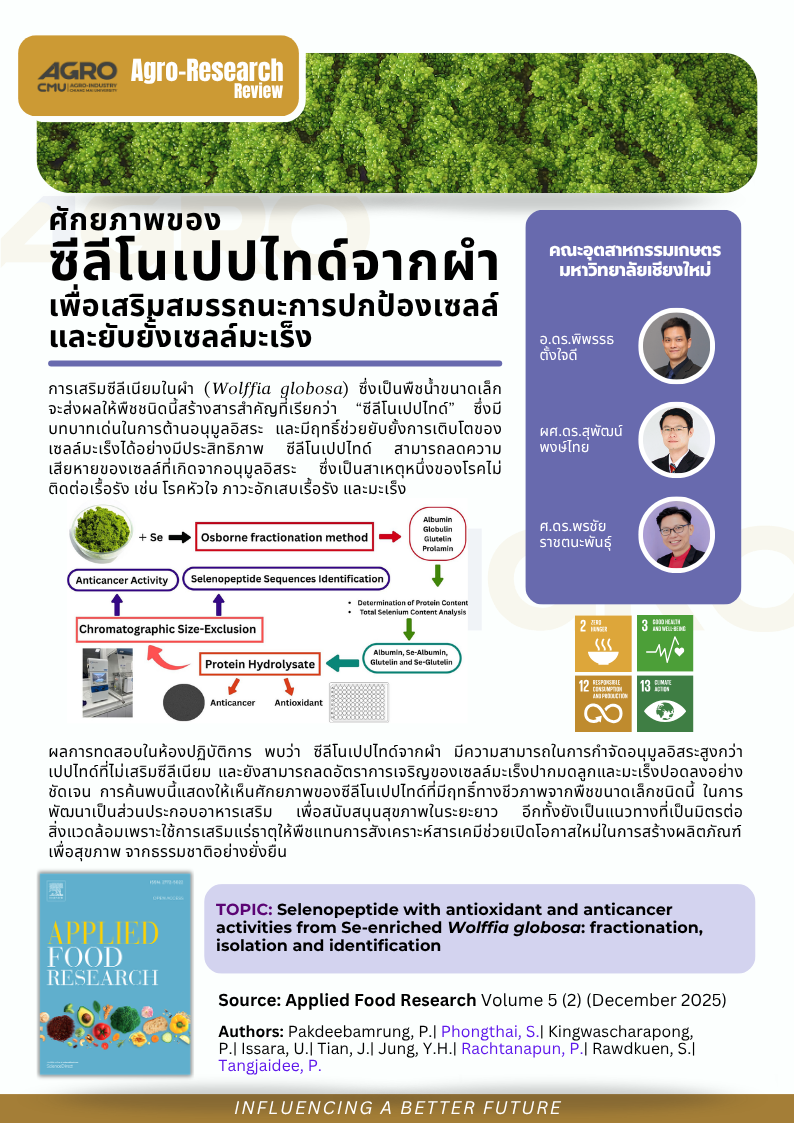
Selenium-enriched Wolffia globosa, a tiny aquatic edible plant, enables the production of “selenopeptides,” natural compound known for their strong antioxidant and anticancer activities. These peptides show protective effect on cells from oxidative stress, one of the key triggers of chronic diseases such as inflammation, cardiovascular disorders, and cancer.
Laboratory results show that selenium‑enriched peptides exhibit notably higher free radical scavenging ability than non-selenium containing peptides. They also significantly reduce the survival of cervical and lung cancer cells, highlighting their potential as plant‑based bioactive ingredients that support long‑term health. This discovery demonstrates how a simple, fast-growing plant can be transformed into a valuable functional resource for supplements and health focused products. At the same time, selenium enrichment is an environmentally friendly approach that avoids synthetic chemical production, offering a sustainable pathway to develop natural health‑promoting solutions.
Topic: Selenopeptide with antioxidant and anticancer activities from Se-enriched Wolffia globosa: fractionation, isolation and identification
Authors: Pakdeebamrung, P.| Phongthai, S.| Kingwascharapong, P.| Issara, U.| Tian, J.| Jung, Y.H.| Rachtanapun, P.| Rawdkuen, S.| Tangjaidee, P.
Abstract:
Bioactive selenopeptides derived from plant materials represent promising candidates for development as plant-derived bioactive agents for applications in health and agriculture. Wolffia globosa, a protein-rich, rootless aquatic plant, has the ability to absorb selenium (Se) from water and synthesize selenopeptide. The study aimed to extract selenoprotein using Osborne fractionation and enzymatic hydrolyzed to produce seleopeptide from Se-enriched W. globosa. Subsequently, the antioxidant and anticancer activities of these selenopeptides were evaluated, and their amino acid sequences were identified. The results indicated that seleno-albumin (SePA) and seleno-glutelin (SePG) are the major fractions derived from selenoproteins in Se-enriched W. globosa, with Se contents of 181.40 and 112.64 μg Se/g protein, respectively. The selenopeptides showed significant antioxidant properties through DPPH (55.90 and 50.75 %), ABTS (54.70 and 44.59 %), FRAP (6.61 and 4.42 mg TE/g) and ORAC (251.21 and 259.39 mg TE/g) radical scavenging assay. Additionally, they exhibited notable anticancer effects against cervical cancer cells (C33A, SiHa) and lung cancer cells (A549), reducing cell viability to below 60 % at 500 μg/mL concentration. Importantly, the selenium-enriched peptides from W. globosa exhibited superior biological activities compared to Se-free peptides, suggesting their potential applications as functional ingredients in the food and pharmaceutical industries.
Source: Applied Food Research Volume 5 (2) (December 2025)
Keywords: Wolffia globosaSe-biotransformationAntioxidant peptideAnticancer peptideSelenopeptide
View at publisher:
https://www.sciencedirect.com/science/article/pii/S2772502225006778
Recent News

 Research newsSep 21, 2026