









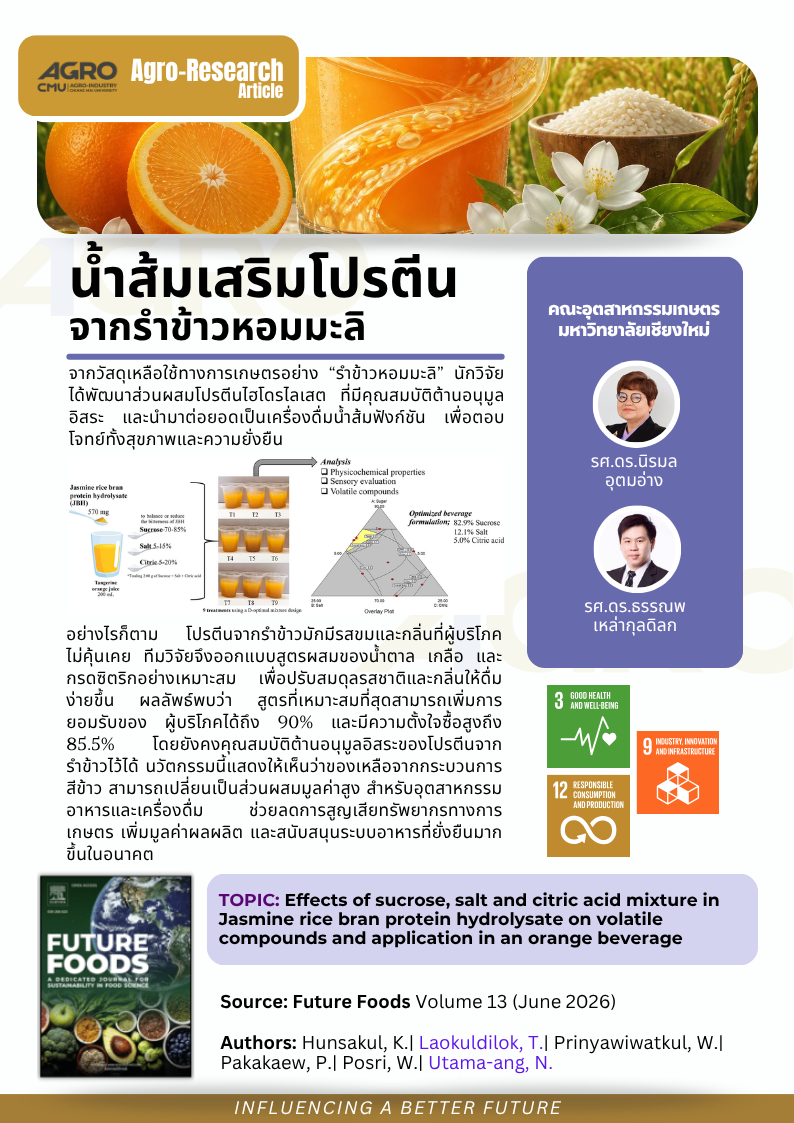
Orange Beverage Fortified with Jasmine Rice Bran Protein Hydrolysate
Research news
Aug 21, 2026
Author: nutthawat.s@cmu.ac.th
What was once an underutilized agricultural by-product, jasmine rice bran, is now being transformed into a high-value functional food ingredient. Researchers developed a jasmine rice bran protein hydrolysate rich in antioxidant properties and incorporated it into an orange beverage. One major challenge was the naturally bitter taste and undesirable aromas often associated with protein hydrolysates. By optimizing the balance of sucrose, salt, and citric acid, the team successfully improved flavor perception and consumer appeal without compromising the beverage’s functional benefits. The optimized formulation achieved 90% consumer acceptance and 85.5% purchase intention, while maintaining the antioxidant potential of the rice bran-derived ingredient. This innovation demonstrates how food industry by-products can be converted into nutritious, market-ready products that benefit both consumers and the environment. By creating added value from agricultural residues, the approach supports more sustainable food systems, reduces waste, and contributes to a circular economy for future food production
Topic: Effects of sucrose, salt and citric acid mixture in Jasmine rice bran protein hydrolysate on volatile compounds and application in an orange beverage
Authors: Hunsakul, K.| Laokuldilok, T.| Prinyawiwatkul, W.| Pakakaew, P.| Posri, W.| Utama-ang, N.
Abstract:
Jasmine rice bran protein hydrolysate (JBH), produced using alcalase and flavourzyme, is a functional ingredient derived from rice bran, a sustainable agricultural by-product. However, its beverage application is limited by bitterness and undesirable volatile compounds. This study investigated the effects of a sucrose–salt–citric acid mixture on physicochemical properties, volatile profiles, and sensory acceptance of a JBH-fortified orange beverage using a D-optimal mixture design. Sucrose (70–85%), salt (5–15%), and citric acid (5–20%) were incorporated at a total amount of 2 g in a 200 mL beverage containing 570 mg JBH. A total of 26 volatile compounds were identified by HS-SPME/GC-MS. Higher consumer acceptance (> 85%) was associated with 3-methyl-butanal, 1-(2-furanyl)-ethanone, 9-hexadecenoic acid, and furfural, whereas 2-octenal, 2-nonenal, 1-heptanol, and acetic acid were linked to lower acceptance (< 75%). The optimized formulation (82.91% sucrose, 12.09% salt, and 5.00% citric acid) achieved slight-to-moderate liking (6.7–7.5) across sensory attributes, with overall acceptance and purchase intent of 90.00% and 85.50%, respectively. These results demonstrate that optimizing sucrose, salt, and citric acid levels improves volatile-related sensory perception, enabling the incorporation of JBH into a consumer-acceptable beverage and supporting sustainable food systems and climate change mitigation through agricultural by-product utilization.
Source: Future Foods Volume 13 (June 2026)
Keywords: Rice bran protein hydrolysate; Orange beverage; Volatile compounds; Sensory acceptance; Sustainable food systems
View at publisher:
https://www.sciencedirect.com/science/article/pii/S2666833526001152
Recent News
 Faculty activitiesOct 1, 2026
 Faculty activitiesSep 28, 2026
 Faculty activitiesSep 28, 2026
 Awards and achievementsSep 25, 2026