






กิจกรรมคณะ
6 ต.ค. 2569


Loading...
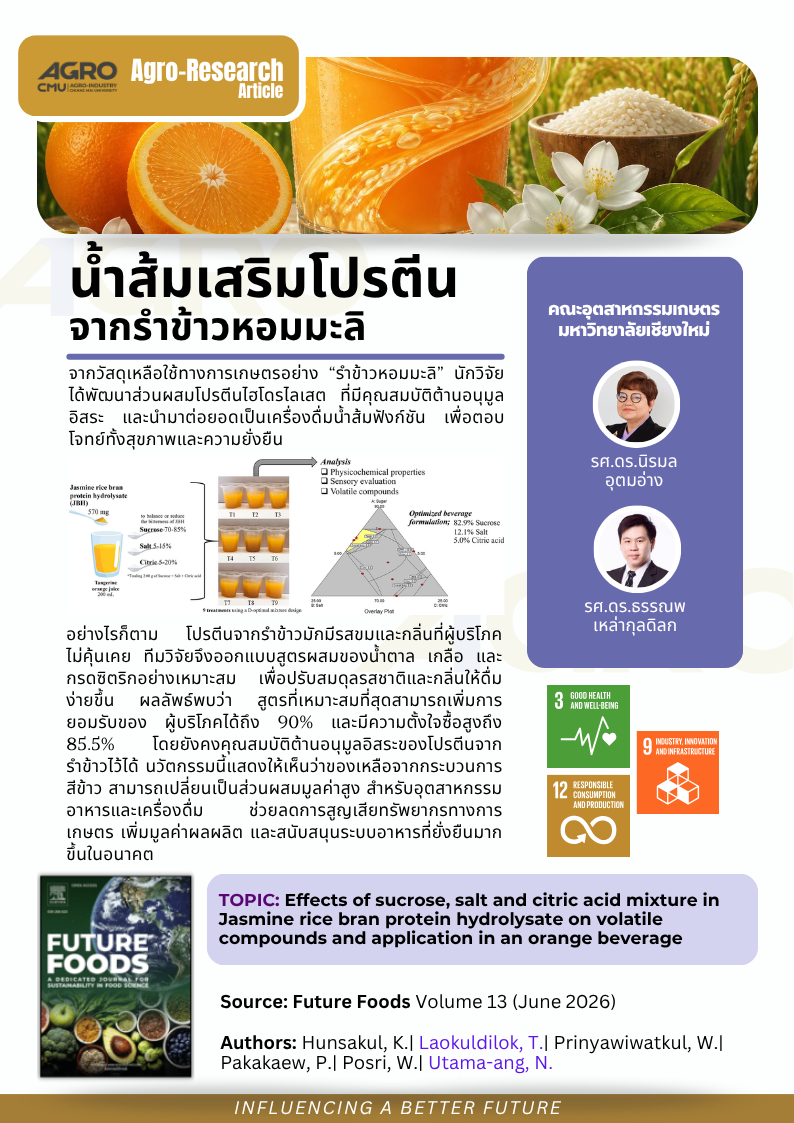
จากวัสดุเหลือใช้ทางการเกษตรอย่าง “รำข้าวหอมมะลิ” นักวิจัยได้พัฒนาส่วนผสมโปรตีนไฮโดรไลเสตที่มีคุณสมบัติต้านอนุมูลอิสระ และนำมาต่อยอดเป็นเครื่องดื่มน้ำส้มฟังก์ชันเพื่อตอบโจทย์ทั้งสุขภาพและความยั่งยืน
อย่างไรก็ตาม โปรตีนจากรำข้าวมักมีรสขมและกลิ่นที่ผู้บริโภคไม่คุ้นเคย ทีมวิจัยจึงออกแบบสูตรผสมของน้ำตาล เกลือ และกรดซิตริกอย่างเหมาะสม เพื่อปรับสมดุลรสชาติและกลิ่นให้ดื่มง่ายขึ้น ผลลัพธ์พบว่าสูตรที่เหมาะสมที่สุดสามารถเพิ่มการยอมรับของผู้บริโภคได้ถึง 90% และมีความตั้งใจซื้อสูงถึง 85.5% โดยยังคงคุณสมบัติต้านอนุมูลอิสระของโปรตีนจากรำข้าวไว้ได้ นวัตกรรมนี้แสดงให้เห็นว่าของเหลือจากกระบวนการสีข้าวสามารถเปลี่ยนเป็นส่วนผสมมูลค่าสูงสำหรับอุตสาหกรรมอาหารและเครื่องดื่ม ช่วยลดการสูญเสียทรัพยากรทางการเกษตร เพิ่มมูลค่าผลผลิต และสนับสนุนระบบอาหารที่ยั่งยืนมากขึ้นในอนาคต
Topic: Effects of sucrose, salt and citric acid mixture in Jasmine rice bran protein hydrolysate on volatile compounds and application in an orange beverage
Authors: Hunsakul, K.| Laokuldilok, T.| Prinyawiwatkul, W.| Pakakaew, P.| Posri, W.| Utama-ang, N.
Abstract:
Jasmine rice bran protein hydrolysate (JBH), produced using alcalase and flavourzyme, is a functional ingredient derived from rice bran, a sustainable agricultural by-product. However, its beverage application is limited by bitterness and undesirable volatile compounds. This study investigated the effects of a sucrose–salt–citric acid mixture on physicochemical properties, volatile profiles, and sensory acceptance of a JBH-fortified orange beverage using a D-optimal mixture design. Sucrose (70–85%), salt (5–15%), and citric acid (5–20%) were incorporated at a total amount of 2 g in a 200 mL beverage containing 570 mg JBH. A total of 26 volatile compounds were identified by HS-SPME/GC-MS. Higher consumer acceptance (> 85%) was associated with 3-methyl-butanal, 1-(2-furanyl)-ethanone, 9-hexadecenoic acid, and furfural, whereas 2-octenal, 2-nonenal, 1-heptanol, and acetic acid were linked to lower acceptance (< 75%). The optimized formulation (82.91% sucrose, 12.09% salt, and 5.00% citric acid) achieved slight-to-moderate liking (6.7–7.5) across sensory attributes, with overall acceptance and purchase intent of 90.00% and 85.50%, respectively. These results demonstrate that optimizing sucrose, salt, and citric acid levels improves volatile-related sensory perception, enabling the incorporation of JBH into a consumer-acceptable beverage and supporting sustainable food systems and climate change mitigation through agricultural by-product utilization.
Source: Future Foods Volume 13 (June 2026)
Keywords: Rice bran protein hydrolysate; Orange beverage; Volatile compounds; Sensory acceptance; Sustainable food systems
View at publisher:
https://www.sciencedirect.com/science/article/pii/S2666833526001152