






Research news
Aug 27, 2026

Loading...
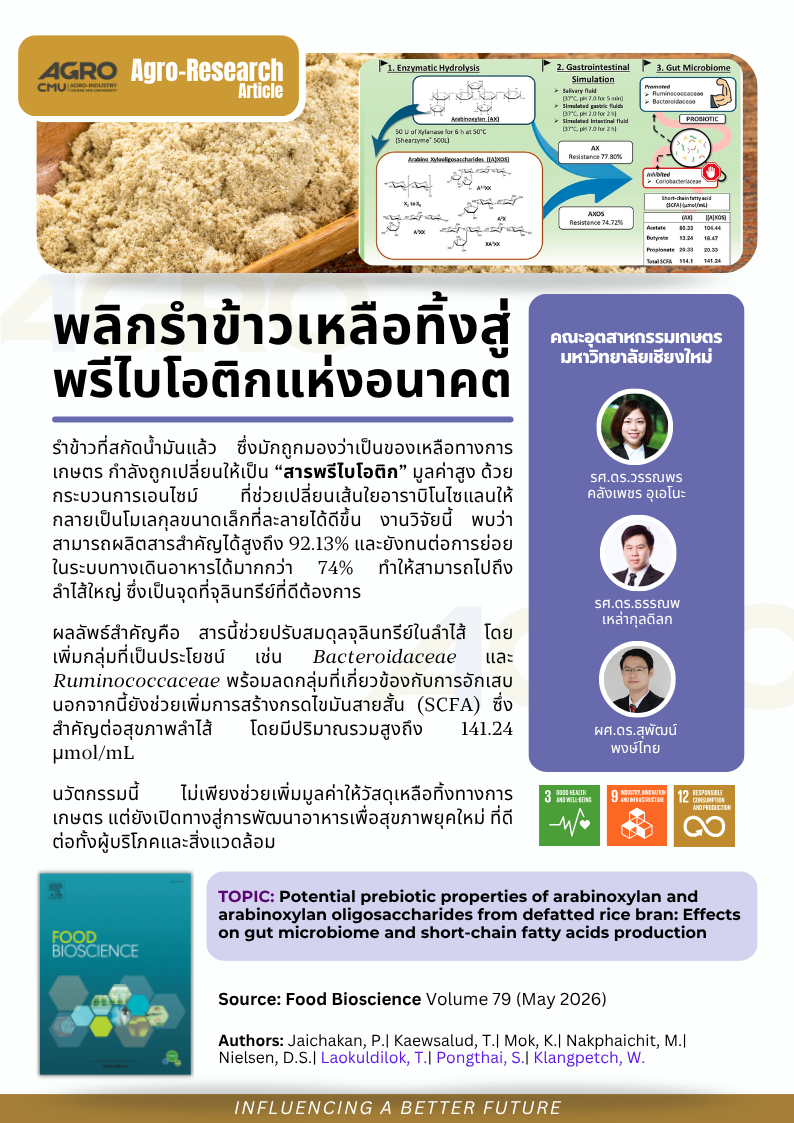
Transforming a rice industry by-product into nourishment for beneficial gut bacteria. This study utilized defatted and deproteinized rice bran as a source of arabinoxylan (AX) and developed an enzymatic process to produce arabinoxylooligosaccharides (AXOS), a promising prebiotic. Under optimized conditions, up to 92.13% of the extracted arabinoxylan was converted into oligosaccharides.
Beyond adding value to an industrial by-product, the resulting AXOS demonstrated promising effects on the human gut microbiome. It helped maintain microbial diversity while selectively promoting beneficial bacterial families, including Bacteroidaceae and Ruminococcaceae, and reducing Coriobacteriaceae, a bacterial family associated with inflammation. AXOS fermentation also increased the production of short-chain fatty acids (SCFAs) to 141.24 μmol/mL, key microbial metabolites that contribute to gut health.
This research goes beyond “turning waste into value” — it transforms an underutilized resource into value for human health. The findings highlight the potential to upcycle rice industry by-products into high-value prebiotic ingredients, creating new opportunities for functional foods and health-promoting products while supporting a more sustainable food industry.
Topic: Potential prebiotic properties of arabinoxylan and arabinoxylan oligosaccharides from defatted rice bran: Effects on gut microbiome and short-chain fatty acids production
Authors: Jaichakan, P.| Kaewsalud, T.| Mok, K.| Nakphaichit, M.| Nielsen, D.S.| Laokuldilok, T.| Pongthai, S.| Klangpetch, W.
Abstract:
Defatted rice bran (DRB) is a sustainable source of arabinoxylan (AX), a hemicellulose with significant prebiotic potential. However, the high viscosity and poor solubility of native AX often limit its industrial application. This study investigated the enzymatic conversion of DRB-AX into defatted rice bran arabinoxylan oligosaccharides (DRB-(A)XOS) using commercial endo-1,4-β-xylanase (Shearzyme® 500L). Optimization of hydrolysis conditions revealed that 50 U/g substrate for 6 h achieved a maximal oligosaccharide yield of 92.13%, predominantly comprising xylobiose, xylotriose, and 32-α-L-arabinofuranosyl-xylobiose. In vitro digestion models simulating the upper gastrointestinal tract demonstrated that DRB-AX and DRB-(A)XOS are highly resistant to enzymatic hydrolysis, with 77.80% and 74.72% of carbohydrates remaining undigested, respectively. Furthermore, in vitro fermentation using a human gut microbiome model highlighted the prebiotic efficacy of DRB-(A)XOS. While commercial xylooligosaccharides reduced microbial alpha-diversity, DRB-(A)XOS maintained community balance while selectively enriching beneficial families, specifically Bacteroidaceae and Ruminococcaceae. Importantly, the treatment significantly reduced the relative abundance of Coriobacteriaceae, a taxon associated with inflammation. Metabolic profiling revealed that DRB-(A)XOS fermentation significantly elevated total short-chain fatty acid (SCFA) production to 141.24 μmol/mL, with acetate being the dominant metabolite (73.94% of total SCFAs). These results suggest that DRB-(A)XOS serves as a potent, digestion-resistant prebiotic ingredient that modulates specific gut taxa and enhances SCFA production, supporting its potential valorization in the functional food industry.
Source: Food Bioscience Volume 79 (May 2026)
Keywords: Defatted rice bran; Prebiotic Arabinoxylan; Arabinoxylan oligosaccharides; Gut microbiome
View at publisher: https://www.sciencedirect.com/science/article/pii/S2212429226005456