






วิจัย
27 ส.ค. 2569

Loading...
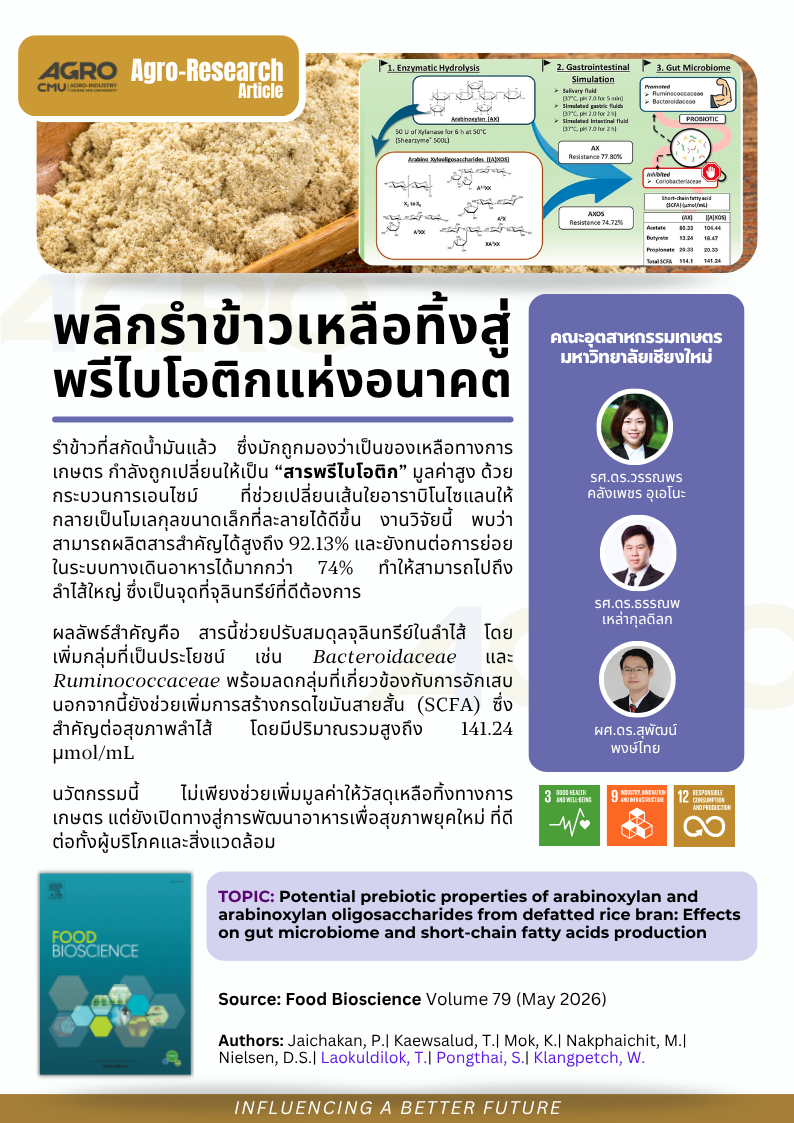
เปลี่ยนผลพลอยได้จากอุตสาหกรรมข้าว ให้กลายเป็นอาหารของจุลินทรีย์ดีในลำไส้ งานวิจัยนี้นำกากรำข้าวที่ผ่านการสกัดไขมันและโปรตีนมาเป็นแหล่งของ อะราบิโนไซแลน และพัฒนากระบวนการย่อยด้วยเอนไซม์เพื่อผลิต อะราบิโนไซโลโอลิโกแซ็กคาไรด์ (AXOS) ซึ่งเป็นสารพรีไบโอติก โดยสามารถเปลี่ยนอะราบิโนไซแลนที่สกัดได้เป็นโอลิโกแซ็กคาไรด์ได้สูงถึง 92.13%
มากกว่าการเพิ่มมูลค่าของเหลือจากอุตสาหกรรม AXOS ที่ได้ยังแสดงศักยภาพต่อ สุขภาพของจุลินทรีย์ในลำไส้ โดยช่วยรักษาสมดุลความหลากหลายของจุลินทรีย์ ส่งเสริมแบคทีเรียที่เป็นประโยชน์ ได้แก่ Bacteroidaceae และ Ruminococcaceae ลดสัดส่วน Coriobacteriaceae ซึ่งสัมพันธ์กับภาวะอักเสบ และเพิ่มการผลิต กรดไขมันสายสั้น (SCFAs) ได้ถึง 141.24 ไมโครโมล/มิลลิลิตร
งานวิจัยนี้จึงไม่เพียง “เปลี่ยนของเหลือให้มีมูลค่า” แต่ยัง “เปลี่ยนให้เป็นคุณค่าต่อสุขภาพ” เปิดโอกาสในการยกระดับผลพลอยได้จากอุตสาหกรรมข้าวไทยสู่ พรีไบโอติกมูลค่าสูง และต่อยอดเป็นส่วนประกอบสำหรับอาหารฟังก์ชันและผลิตภัณฑ์เพื่อสุขภาพในอนาคต
Topic: Potential prebiotic properties of arabinoxylan and arabinoxylan oligosaccharides from defatted rice bran: Effects on gut microbiome and short-chain fatty acids production
Authors: Jaichakan, P.| Kaewsalud, T.| Mok, K.| Nakphaichit, M.| Nielsen, D.S.| Laokuldilok, T.| Pongthai, S.| Klangpetch, W.
Abstract:
Defatted rice bran (DRB) is a sustainable source of arabinoxylan (AX), a hemicellulose with significant prebiotic potential. However, the high viscosity and poor solubility of native AX often limit its industrial application. This study investigated the enzymatic conversion of DRB-AX into defatted rice bran arabinoxylan oligosaccharides (DRB-(A)XOS) using commercial endo-1,4-β-xylanase (Shearzyme® 500L). Optimization of hydrolysis conditions revealed that 50 U/g substrate for 6 h achieved a maximal oligosaccharide yield of 92.13%, predominantly comprising xylobiose, xylotriose, and 32-α-L-arabinofuranosyl-xylobiose. In vitro digestion models simulating the upper gastrointestinal tract demonstrated that DRB-AX and DRB-(A)XOS are highly resistant to enzymatic hydrolysis, with 77.80% and 74.72% of carbohydrates remaining undigested, respectively. Furthermore, in vitro fermentation using a human gut microbiome model highlighted the prebiotic efficacy of DRB-(A)XOS. While commercial xylooligosaccharides reduced microbial alpha-diversity, DRB-(A)XOS maintained community balance while selectively enriching beneficial families, specifically Bacteroidaceae and Ruminococcaceae. Importantly, the treatment significantly reduced the relative abundance of Coriobacteriaceae, a taxon associated with inflammation. Metabolic profiling revealed that DRB-(A)XOS fermentation significantly elevated total short-chain fatty acid (SCFA) production to 141.24 μmol/mL, with acetate being the dominant metabolite (73.94% of total SCFAs). These results suggest that DRB-(A)XOS serves as a potent, digestion-resistant prebiotic ingredient that modulates specific gut taxa and enhances SCFA production, supporting its potential valorization in the functional food industry.
Source: Food Bioscience Volume 79 (May 2026)
Keywords: Defatted rice bran; Prebiotic Arabinoxylan; Arabinoxylan oligosaccharides; Gut microbiome
View at publisher: https://www.sciencedirect.com/science/article/pii/S2212429226005456