









More Than Packaging: Naturally Tenderizing Meat Through Innovation Bioactive Packaging Powered by Natural Enzymes
Research news
Sep 7, 2026
Author: nutthawat.s@cmu.ac.th
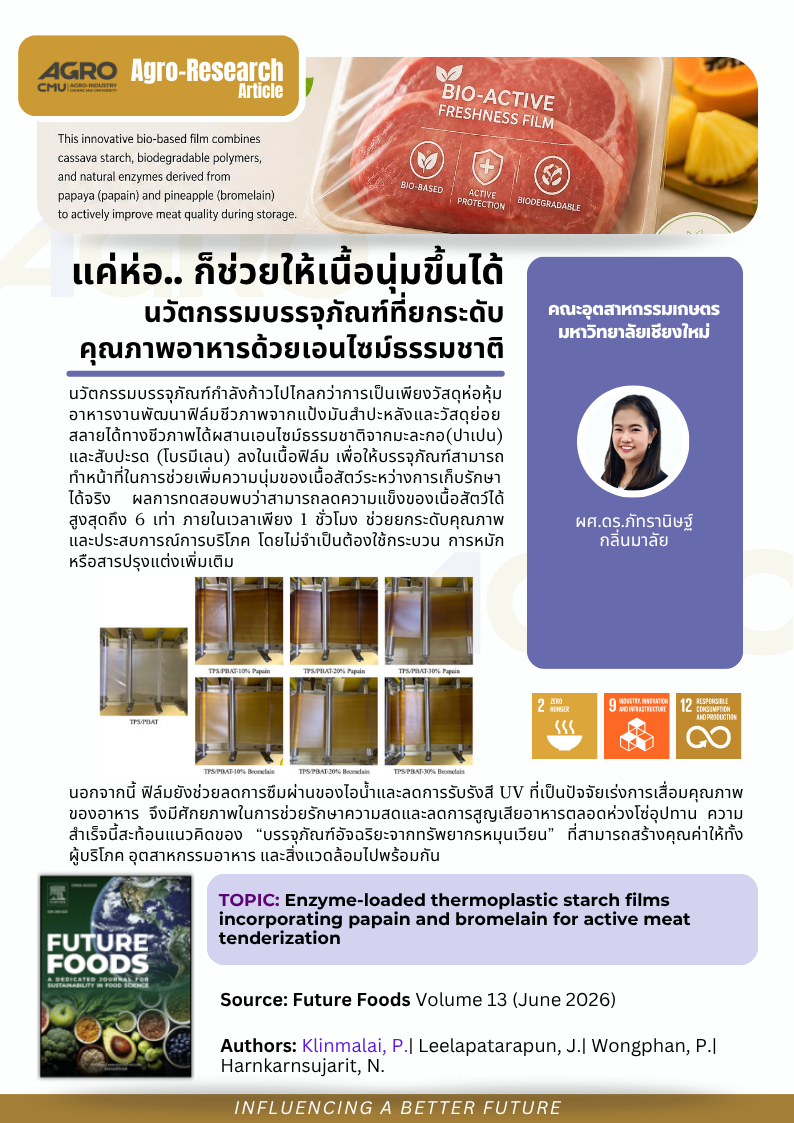
Packaging is evolving beyond its traditional role as a protective barrier. This innovative bio-based film combines cassava starch, biodegradable polymers, and natural enzymes derived from papaya (papain) and pineapple (bromelain) to actively improve meat quality during storage. The enzyme-infused film can reduce meat hardness by up to six times within just one hour, delivering a more tender texture without additional marination or chemical additives. Beyond enhancing eating quality, the film also improves moisture resistance and blocks UV light, helping to preserve freshness and reduce food deterioration. By integrating natural functionality directly into the packaging, this technology offers a smarter way to maintain product quality and minimize food waste across the supply chain.
The development highlights the future of sustainable active packaging, where renewable materials not only protect food but also create tangible benefits for consumers, industry, and the environment.
Topic: Enzyme-loaded thermoplastic starch films incorporating papain and bromelain for active meat tenderization
Authors: Klinmalai, P.| Leelapatarapun, J.| Wongphan, P.| Harnkarnsujarit, N.
Abstract:
Incorporating proteolytic enzymes into thermoplastic starch (TPS)-based biopolymers presents a novel strategy for developing active packaging films capable of enhancing meat tenderness. However, preserving enzyme activity during high-temperature extrusion remains a major challenge. This study developed cassava TPS/poly (butylene adipate-co-terephthalate) (PBAT) films incorporating papain and bromelain at 10 %, 20 %, and 30 % (w/w) using a continuous extrusion process optimized to minimize thermal degradation. The films retained significant enzymatic activity, improving meat tenderness by up to sixfold, with hardness reduced from 4.20 ± 0.29 N (fresh meat) to 0.65 ± 0.07 N (10 % papain) and 1.10 ± 0.26 N (10 % bromelain) after 1 h of aging. FTIR spectra showed band shifts from 3323 cm⁻¹ to 3338 cm⁻¹ (papain) and 3329 cm⁻¹ (bromelain), confirming enzyme–polymer hydrogen-bond interactions. Dynamic mechanical thermal analysis (DMTA) revealed that papain decreased rigidity through plasticization, whereas bromelain increased the glass transition temperature due to network reinforcement. The water vapor permeability decreased from 5.49 ± 0.30 g·mm/m²·day·KPa (control) to 3.06 ± 0.16 g·mm/m²·day·KPa (30 % papain), while oxygen permeability increased from 4.71 ± 1.43 to 13.95 ± 0.57 cm³·mm/m²·day·KPa, indicating modified gas transport behavior. Films with 10 % enzyme loading exhibited the best balance between enzyme activity, barrier properties, and structural integrity. These findings demonstrate that enzyme-active TPS/PBAT films are promising for scalable, bio-based packaging applications that improve meat tenderness and quality during storage.
Source: Future Foods Volume 13 (June 2026)
Keywords: Active packaging; Texture; Meat; Tenderness; Advanced material
View at publisher: https://www.sciencedirect.com/science/article/pii/S2666833525003144