







แค่ห่อ ก็ช่วยให้เนื้อนุ่มขึ้นได้ นวัตกรรมบรรจุภัณฑ์ที่ยกระดับคุณภาพอาหารด้วยเอนไซม์ธรรมชาติ
วิจัย
7 ก.ย. 2569
ผู้เขียน: nutthawat.s@cmu.ac.th
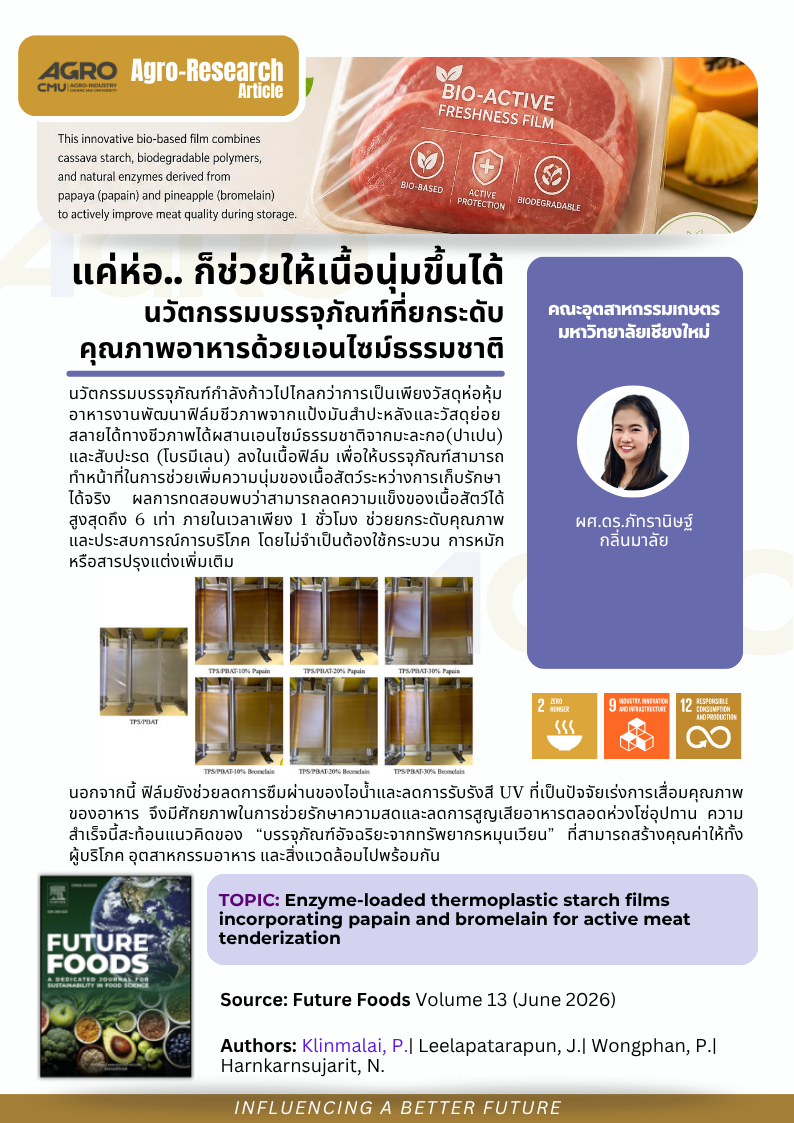
นวัตกรรมบรรจุภัณฑ์กำลังก้าวไปไกลกว่าการเป็นเพียงวัสดุห่อหุ้มอาหาร งานพัฒนาฟิล์มชีวภาพจากแป้งมันสำปะหลังและวัสดุย่อยสลายได้ทางชีวภาพได้ผสานเอนไซม์ธรรมชาติจากมะละกอ (ปาเปน) และสับปะรด (โบรมีเลน) ลงในเนื้อฟิล์ม เพื่อให้บรรจุภัณฑ์สามารถทำหน้าที่เชิงรุกในการช่วยเพิ่มความนุ่มของเนื้อสัตว์ระหว่างการเก็บรักษาได้จริง ผลการทดสอบพบว่าสามารถลดความแข็งของเนื้อสัตว์ได้สูงสุดถึง 6 เท่า ภายในเวลาเพียง 1 ชั่วโมง ช่วยยกระดับคุณภาพและประสบการณ์การบริโภคโดยไม่จำเป็นต้องใช้กระบวนการหมักหรือสารปรุงแต่งเพิ่มเติม
นอกจากนี้ ฟิล์มยังช่วยลดการซึมผ่านของไอน้ำและลดการรับรังสี UV ที่เป็นปัจจัยเร่งการเสื่อมคุณภาพของอาหาร จึงมีศักยภาพในการช่วยรักษาความสดและลดการสูญเสียอาหารตลอดห่วงโซ่อุปทาน ความสำเร็จนี้สะท้อนแนวคิดของ “บรรจุภัณฑ์อัจฉริยะจากทรัพยากรหมุนเวียน” ที่สามารถสร้างคุณค่าให้ทั้งผู้บริโภค อุตสาหกรรมอาหาร และสิ่งแวดล้อมไปพร้อมกัน
Topic: Enzyme-loaded thermoplastic starch films incorporating papain and bromelain for active meat tenderization
Authors: Klinmalai, P.| Leelapatarapun, J.| Wongphan, P.| Harnkarnsujarit, N.
Abstract:
Incorporating proteolytic enzymes into thermoplastic starch (TPS)-based biopolymers presents a novel strategy for developing active packaging films capable of enhancing meat tenderness. However, preserving enzyme activity during high-temperature extrusion remains a major challenge. This study developed cassava TPS/poly (butylene adipate-co-terephthalate) (PBAT) films incorporating papain and bromelain at 10 %, 20 %, and 30 % (w/w) using a continuous extrusion process optimized to minimize thermal degradation. The films retained significant enzymatic activity, improving meat tenderness by up to sixfold, with hardness reduced from 4.20 ± 0.29 N (fresh meat) to 0.65 ± 0.07 N (10 % papain) and 1.10 ± 0.26 N (10 % bromelain) after 1 h of aging. FTIR spectra showed band shifts from 3323 cm⁻¹ to 3338 cm⁻¹ (papain) and 3329 cm⁻¹ (bromelain), confirming enzyme–polymer hydrogen-bond interactions. Dynamic mechanical thermal analysis (DMTA) revealed that papain decreased rigidity through plasticization, whereas bromelain increased the glass transition temperature due to network reinforcement. The water vapor permeability decreased from 5.49 ± 0.30 g·mm/m²·day·KPa (control) to 3.06 ± 0.16 g·mm/m²·day·KPa (30 % papain), while oxygen permeability increased from 4.71 ± 1.43 to 13.95 ± 0.57 cm³·mm/m²·day·KPa, indicating modified gas transport behavior. Films with 10 % enzyme loading exhibited the best balance between enzyme activity, barrier properties, and structural integrity. These findings demonstrate that enzyme-active TPS/PBAT films are promising for scalable, bio-based packaging applications that improve meat tenderness and quality during storage.
Source: Future Foods Volume 13 (June 2026)
Keywords: Active packaging; Texture; Meat; Tenderness; Advanced material
View at publisher: https://www.sciencedirect.com/science/article/pii/S2666833525003144