








Plasma Technology: Preserving Valuable Compounds in Butterfly Pea Extract Without Heat
Research news
Sep 21, 2026
Author: nutthawat.s@cmu.ac.th
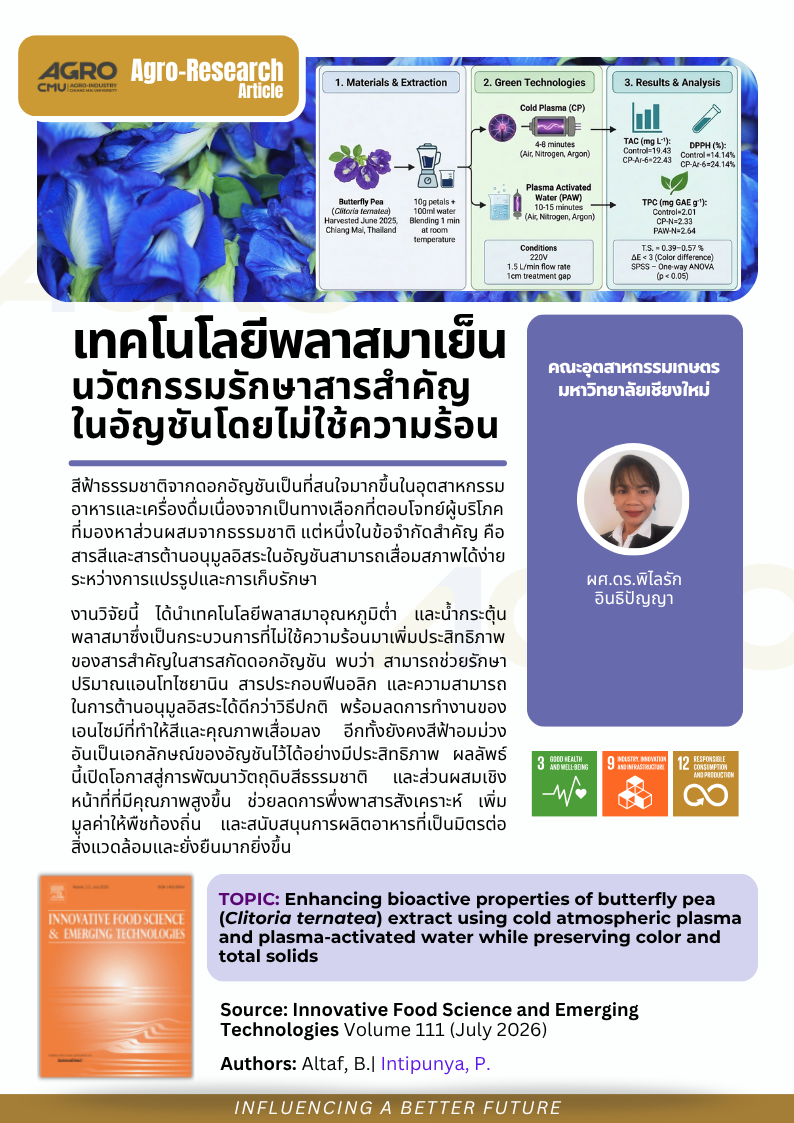
Natural blue pigments from butterfly pea flowers are gaining attention as consumers increasingly seek clean-label and plant-based ingredients. However, the bioactive compounds responsible for their vibrant color and antioxidant benefits are often unstable during processing and storage. This work demonstrates how cold atmospheric plasma and plasma-activated water, two innovative non-thermal technologies, can enhance the quality of butterfly pea extracts without relying on heat. The treatments improved the retention of anthocyanins, phenolic compounds, and antioxidant activity while reducing the activity of enzymes that contribute to color loss and quality deterioration. Importantly, the characteristic blue-violet color of the extract was largely preserved. These findings highlight a promising pathway for developing next-generation natural colorants and functional ingredients with improved stability and performance. Beyond food innovation, the technology supports more sustainable manufacturing by reducing dependence on synthetic additives, promoting the use of plant-derived ingredients, and enabling the creation of healthier, environmentally friendly products for future consumers.
Topic: Enhancing bioactive properties of butterfly pea (Clitoria ternatea) extract using cold atmospheric plasma and plasma-activated water while preserving color and total solids
Authors: Altaf, B.| Intipunya, P.
Abstract:
Butterfly pea (Clitoria ternatea) flowers contain abundant anthocyanins and phenolic compounds, functioning as natural colorants and antioxidant agents; however, their limited stability restricts industrial application. This study investigated cold atmospheric plasma (CAP) and plasma-activated water (PAW) as mild, non-thermal, green technologies to enhance the stability and bioactivity of aqueous extracts. CAP treatments were conducted using air, nitrogen, or argon for 4–8 min, while PAW was generated from the same gases for 10–15 min. Extracts were evaluated for total phenolic content (TPC), total anthocyanin content (TAC), total flavonoid content (TFC), ferric reducing antioxidant power (FRAP), 2,2-diphenyl-1-picrylhydrazyl free radical scavenging activity (DPPH), polyphenol oxidase (PPO) activity, color attributes, pH, and total solids. Compared with the untreated control, all plasma-treated samples showed significant improvements (p < 0.05). Under CAP, Ar-6 min yielded the highest TAC (22.43 ± 0.31 mg/L), whereas Ar-8 min achieved the highest TPC (2.26 ± 0.05 mg GAE g−1 fresh weight). Nitrogen plasma exhibited the highest DPPH radical-scavenging activity (24.14% inhibition) and effectively suppressed PPO activity. In PAW treatments, phenolic content peaked at 12 min under PAW-Air (2.69 mg GAE g−1 fresh weigh, and TAC was highest under PAW-N₂ (21.01 ± 0.83 mg/L). Color differences exceeded the perceptibility threshold (ΔE > 3) in some CAP treatments but remained below 2.8 for all PAW treatments. Nitrogen preserved the violet hue of anthocyanins, while pH decreased slightly (∼5.1 to 4.9) without affecting total solids. Overall, CAP with argon most effectively preserved pigment integrity and suppressed PPO activity, whereas PAW with air maximized phenolic recovery and antioxidant activity. These findings confirm that plasma technologies represent sustainable strategies for stabilizing natural blue colorants, with strong potential for the development of functional ingredients and innovative food products.
Source: Innovative Food Science and Emerging Technologies Volume 111 (July 2026)
Keywords: Cold atmospheric plasma; Plasma-activated water; Anthocyanins; Bioactivity; Innovative functional ingredients; Sustainable food
View at publisher: https://www.sciencedirect.com/science/article/pii/S1466856426001748
Recent News
- Research newsSep 21, 2026
 Faculty activitiesSep 18, 2026
 Faculty activitiesSep 17, 2026
 Awards and achievementsSep 16, 2026