









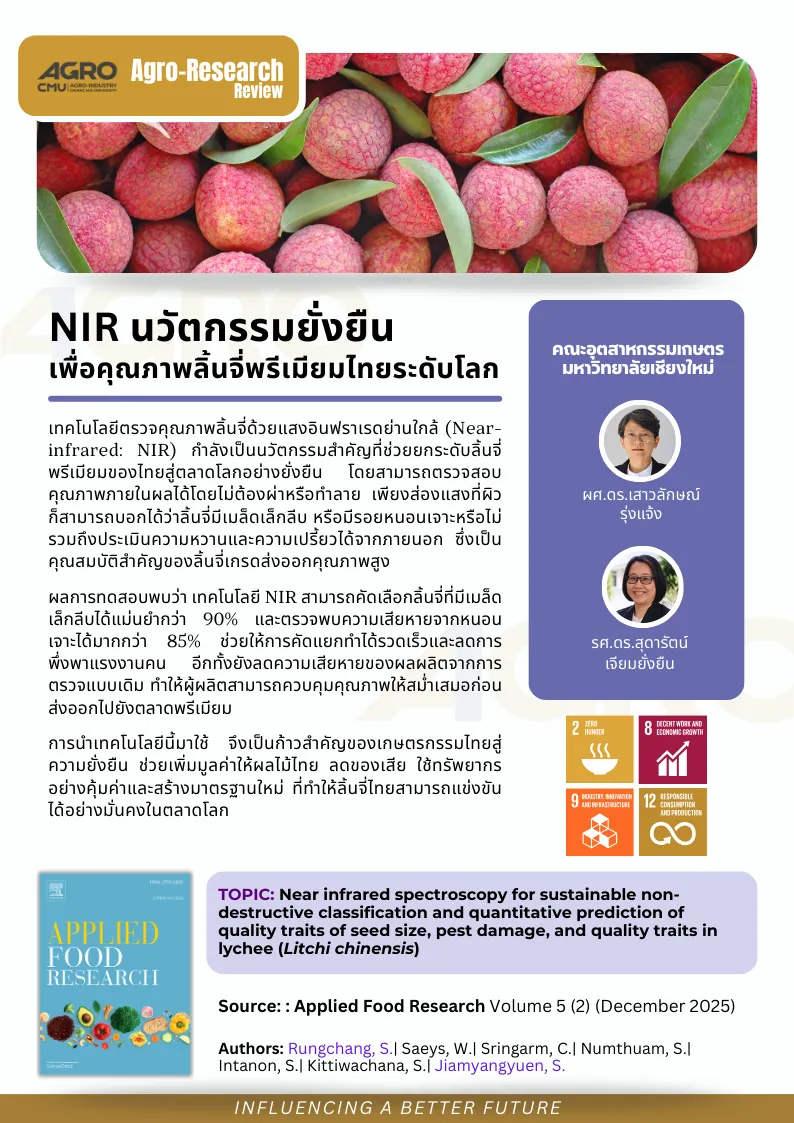
Sustainable NIR Innovation for Premium Thai Lychees in Global Markets
Research news
Feb 24, 2026
Author: nutthawat.s@cmu.ac.th
Near-infrared (NIR) technology is emerging as an important innovation to sustainably elevate premium Thai lychees to the global market. This method can assess the internal quality of the fruit without cutting or damaging it. By simply scanning the fruit surface, it can determine whether the lychee has a small or aborted seed, detect signs of fruit borer damage, and even estimate sweetness and acidity from the outside—key attributes for high-value export-grade lychees.
Test results showed that NIR technology can identify lychees with small or aborted seeds with over 90% accuracy and detect fruit borer damage with more than 85% accuracy. This enables faster sorting, reduces reliance on manual labor, and minimizes fruit damage from traditional inspection methods. Producers can therefore ensure consistent quality before exporting to premium markets worldwide.
The adoption of this technology represents a significant step toward sustainable Thai agriculture. It adds value to Thai fruits, reduces waste, promotes efficient resource use, and helps establish new quality standards that strengthen the competitiveness of Thai lychees in the global market.
Topic: Near infrared spectroscopy for sustainable non-destructive classification and quantitative prediction of quality traits of seed size, pest damage, and quality traits in lychee (Litchi chinensis)
Authors: Rungchang, S.| Saeys, W.| Sringarm, C.| Numthuam, S.| Intanon, S.| Kittiwachana, S.| Jiamyangyuen, S.
Abstract:
Lychees are highly valued in export markets if they have an aborted seed and are free from fruit borer damage. However, the traditional grading method relies on manual assessment by laborers, which is experience-dependent, time-consuming, and potentially destructive to the fruit. The objective of this study was to evaluate NIR spectroscopy for classifying premium lychee fruits based on seed size and the absence of fruit borer damage, as well as for quantifying the soluble solids content (SSC) and titratable acidity (TA). NIR spectra in the 12,000–4000 cm⁻¹ range were acquired in reflectance mode at three different positions: stem end, cheek side, and tip. The classification models effectively distinguished seed size at tip side, achieving 90.58 % accuracy and fruit borer damage at stem-end, resulting in 85.71 % and 90.91 % correct classification for normal and aborted seeds, respectively. Additionally, SSC and TA content were quantitatively assessed from the NIR spectra with R2 values > 0.90. These results could pave the way for efficient quality control of lychees. This research advances innovative sensing technologies for agriculture while enabling sustainable production and resource-efficient food systems.
Source: Applied Food Research Volume 5 (2) (December 2025)
Keywords: Fruit physiology; Postharvest grading; Quality assessment; Chemometrics; NIR spectroscopy
View at publisher: https://www.sciencedirect.com/science/article/pii/S2772502225008571?via%3Dihub
Recent News


 Faculty activitiesAug 24, 2026
 Awards and achievementsAug 24, 2026