








From Herb to Innovation: Reinventing Fingerroot Bioactives
Research news
May 20, 2026
Author: nutthawat.s@cmu.ac.th
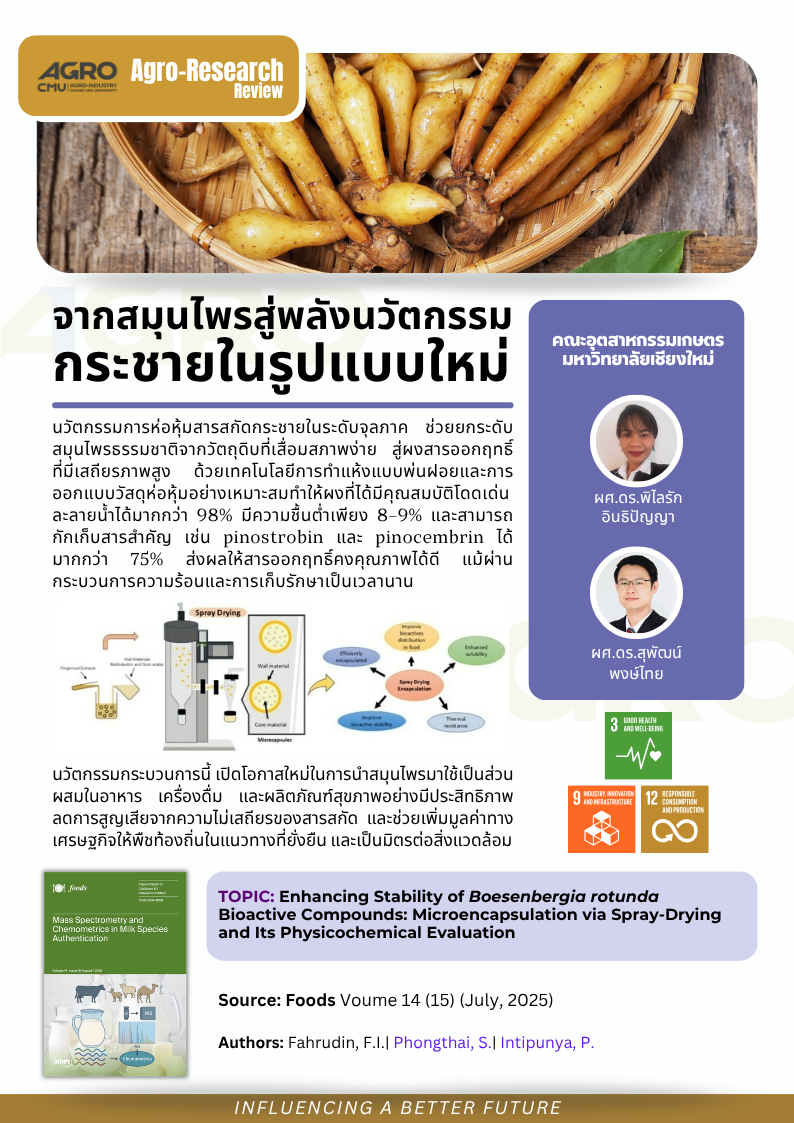
This innovation transforms fragile fingerroot bioactives into a highly stable powder through microencapsulation and spray-drying technology. By optimizing the protective wall materials, the resulting powder achieves over 98% solubility, low moisture content of around 8–9%, and encapsulation efficiency exceeding 75%, even after heat exposure. Key bioactive compounds such as pinostrobin and pinocembrin are effectively preserved, enhancing their practical use in food, beverage, and health applications.
This breakthrough extends shelf life, improves handling, and enables precise formulation with natural ingredients. Beyond functionality, the innovation supports sustainable use of plant resources by reducing loss from degradation and creating high-value ingredients from traditional herbs, bridging the gap between local biodiversity and modern functional product development.
Topic: Enhancing Stability of Boesenbergia rotunda Bioactive Compounds: Microencapsulation via Spray-Drying and Its Physicochemical Evaluation
Authors: Fahrudin, F.I.| Phongthai, S.| Intipunya, P.
Abstract:
This study aimed to microencapsulate Boesenbergia rotunda (fingerroot) extract using maltodextrin (MD) and gum arabic (GA) as wall materials via spray-drying to improve powder physicochemical properties and protect bioactive compounds. MD and GA were employed as wall materials in varying ratios (MD:GA of 1:0, 0:1, 1:1, 2:1, 1:2) to evaluate their effects on the physicochemical properties of the resulting microcapsules. Spray-dried microcapsules were evaluated for morphology, flowability, particle size distribution, moisture content, hygroscopicity, solubility, encapsulation efficiency, major bioactive compound retention, and thermal stability. The extract encapsulation using MD:GA at 1:1 ratio (MD1GA1) demonstrated a favorable balance, with high solubility (98.70%), low moisture content (8.69%), low hygroscopicity (5.08%), and uniform particle morphology, despite its moderate EE (75.06%). SEM images revealed spherical particles with fewer surface indentations in MD-rich formulations. Microencapsulation effectively retained pinostrobin and pinocembrin in all formulations with pinostrobin consistently retained at a higher value, indicating its higher stability. The balanced profile of physical and functional properties of fingerroot extract with MD1GA1 microcapsule makes it a promising candidate for food and nutraceutical applications.
Source: Foods Voume 14 (15) (July, 2025)
Keywords: fingerroot; microencapsulation; encapsulation efficiency; stability; bioactive contents; powder properties
View at publisher: https://www.mdpi.com/2304-8158/14/15/2699
Recent News


 Faculty activitiesAug 24, 2026
 Awards and achievementsAug 24, 2026