







Blue Light and Riboflavin for Safer Fresh Betel Leaves
Research news
Mar 18, 2026
Author: nutthawat.s@cmu.ac.th
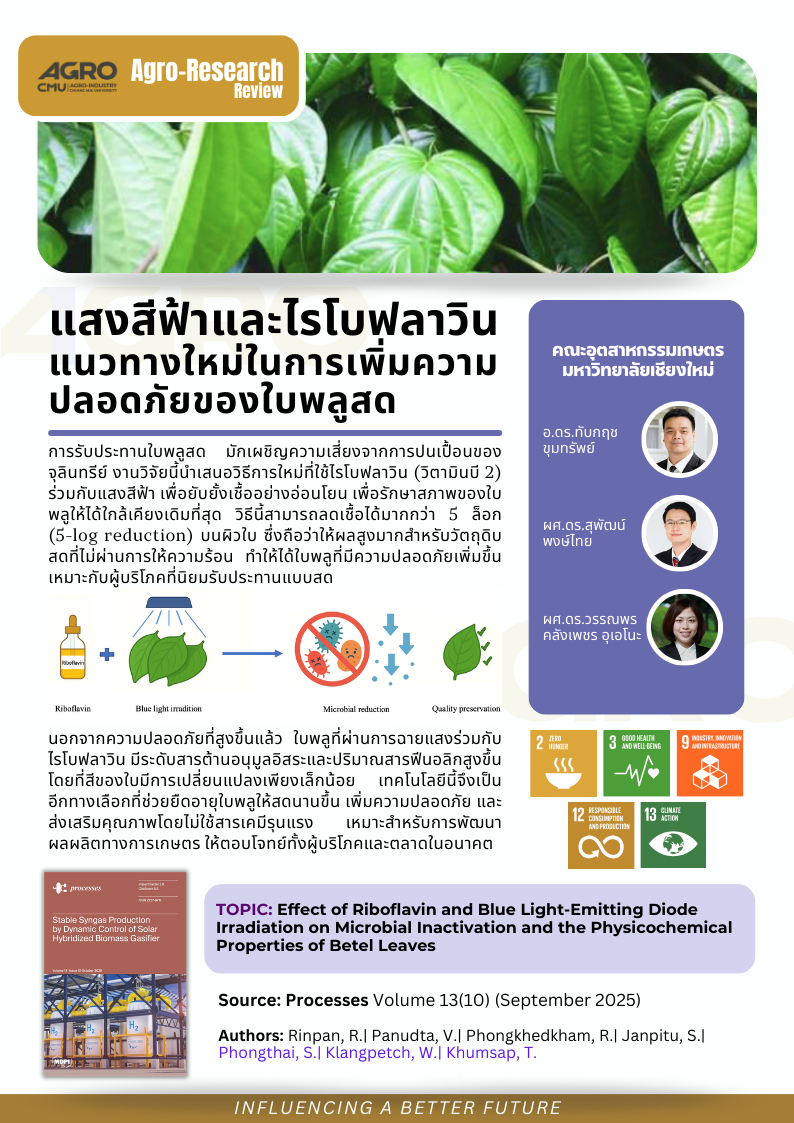
Fresh betel leaves may carry harmful microorganisms, particularly when they are consumed fresh. This study introduces a mild treatment that combines riboflavin (vitamin B2) with blue LED light to significantly reduce microbial contamination on the leaf surface. The treatment achieved more than a 5-log reduction in bacterial populations, offering a safer option for consumers who prefer fresh betel leaves.
Beyond improving safety, the process also enhanced several quality attributes. Treated leaves showed increased antioxidant activity, higher phenolic content, and a slight increase in total soluble solids, while only minor changes in leaf color were observed.
This approach provides a promising strategy to improve the microbial safety of betel leaves while preserving their natural quality, offering potential benefits for fresh produce handling and future food markets.
Topic: Effect of Riboflavin and Blue Light-Emitting Diode Irradiation on Microbial Inactivation and the Physicochemical Properties of Betel Leaves
Authors: Rinpan, R.| Panudta, V.| Phongkhedkham, R.| Janpitu, S.| Phongthai, S.| Klangpetch, W.| Khumsap, T.
Abstract:
This study evaluated the effectiveness of photodynamic treatment (PDT) using riboflavin (Rbf) and blue light-emitting diode (BL) irradiation for microbial inactivation and quality preservation in fresh betel leaves (Piper betle L.). Non-pathogenic surrogates Escherichia coli K-12 and Listeria innocua were used to model Gram-negative and Gram-positive bacteria. The combined Rbf-BL treatment significantly reduced microbial populations by up to 5.3 log CFU/g for E. coli and 6.2 log CFU/g for L. innocua on leaf surfaces (p < 0.05) and 1.3–1.5 log CFU/mL in broth cultures. Treated samples showed significantly higher total soluble solids (12.0 ± 0.0 °Brix), total phenolic content (0.17 ± 0.02 mmol GAE/g, p < 0.05), and antioxidant activity (62.0 ± 3.1% DPPH inhibition, p < 0.05), with minimal color alteration after treatment (ΔE = 4.68). The total fluence measured at the leaf surface was approximately 11.72 J/cm2. As a mild thermal treatment utilizing a GRAS photosensitizer, riboflavin-assisted PDT presents a promising strategy for enhancing microbial safety and promoting phytochemical quality in betel leaves.
Source: Processes Volume 13(10) (September 2505)
Recent News
 Faculty activitiesAug 24, 2026
 Awards and achievementsAug 24, 2026
 Awards and achievementsAug 21, 2026
 Awards and achievementsAug 24, 2026