








Transforming Cricket By Products into High Quality Chitin: A New Step Toward Sustainable Biomaterials
Research news
Apr 1, 2026
Author: nutthawat.s@cmu.ac.th
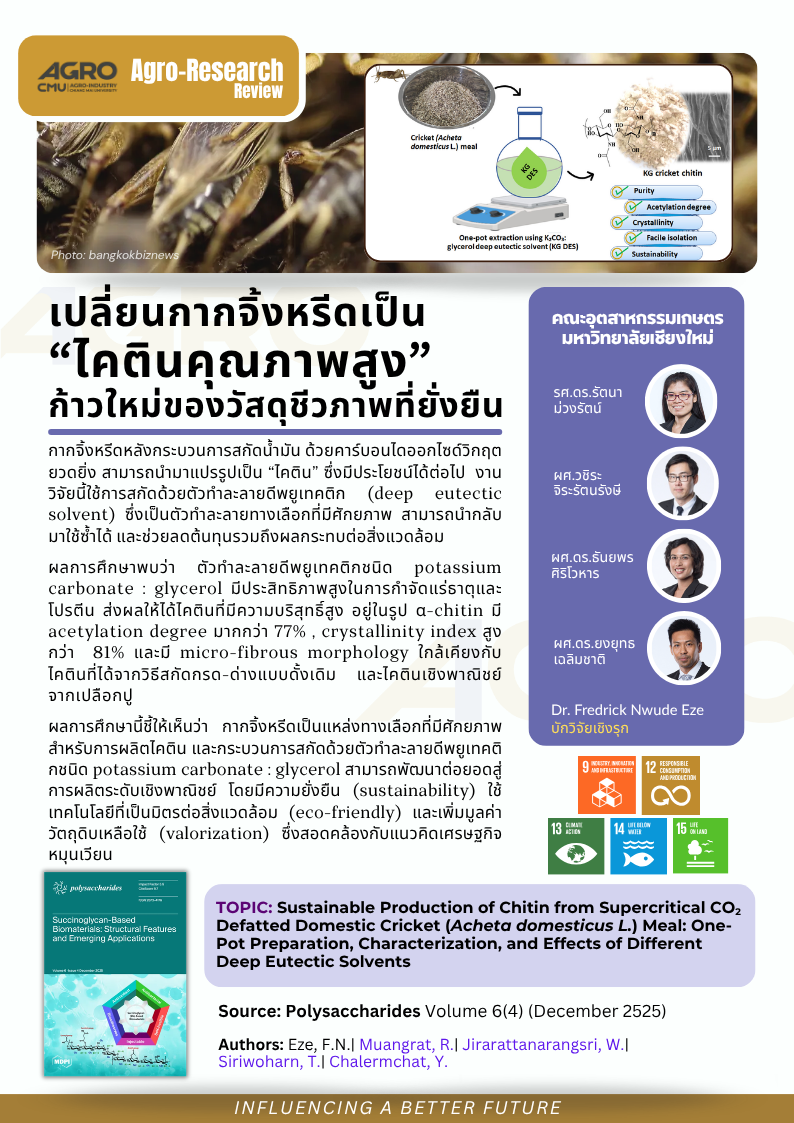
Defatted cricket meal obtained after supercritical CO₂ oil extraction can be further processed into chitin, a valuable biopolymer with diverse applications. This study employs deep eutectic solvents (DES) as an alternative extraction medium with strong potential, offering recyclability, lower overall cost, and reduced environmental impact.
The findings show that the potassium carbonate : glycerol DES provides highly effective demineralization and deproteinization, yielding chitin of high purity in the α‑chitin form, with an acetylation degree above 77%, a crystallinity index over 81%, and a micro‑fibrous morphology comparable to chitin extracted via conventional acid–alkali methods and commercial crab‑shell chitin.
These results indicate that cricket meal is a promising alternative raw material for chitin production. Moreover, the potassium carbonate : glycerol DES extraction process has strong potential for scale‑up to commercial production due to its sustainability, eco‑friendly characteristics, and ability to valorize agricultural and food by‑products—aligning well with the principles of a circular economy.
Topic: Sustainable Production of Chitin from Supercritical CO2 Defatted Domestic Cricket (Acheta domesticus L.) Meal: One-Pot Preparation, Characterization, and Effects of Different Deep Eutectic Solvents
Authors: Eze, F.N.| Muangrat, R.| Jirarattanarangsri, W.| Siriwoharn, T.| Chalermchat, Y.
Abstract:
Current resource and processing constraints on conventional chitin production call for novel sources and more sustainable methods for its production. Herein, domestic cricket (Acheta domesticus L.) meal obtained from supercritical CO2 oil extraction was investigated as a viable source of chitin via a one-pot approach using acidic (choline chloride: glycerol, CCG) and alkaline (potassium carbonate: glycerol, KG) deep eutectic solvents (DESs). The chitin samples obtained were compared with those obtained using conventional acid-alkaline extraction (CE) and commercial crab shell chitin (CS chitin) by robust characterization of their composition and physicochemical properties employing color, FTIR, XRD, XPS, and SEM analysis. The results showed that KG DES and recovered KG DES exhibited high demineralization and deproteinization capacity, producing chitin with high purity, α-chitin form, high acetylation degree (>77%), crystallinity (crystallinity index > 81%), and micro-fibrous morphology closely similar to those of CE chitin and CS chitin. Whereas CCG DES demonstrated excellent demineralization, it was less effective at deproteinization, leading to chitin with lower purity and crystalline properties. Together, the results demonstrated that cricket meal could be an alternative source of chitin, while KG DES one-pot extraction holds strong potential as a sustainable and eco-friendly approach for obtaining commercial-grade chitin.
Source: Polysaccharides Volume 6(4) (December 2525)
Keywords: Acheta domesticus L.; sustainable chitin recovery; deep eutectic solvent extraction; insect chitin
View at publisher: https://www.mdpi.com/2673-4176/6/4/115
Recent News
 Faculty activitiesAug 24, 2026
 Awards and achievementsAug 24, 2026