









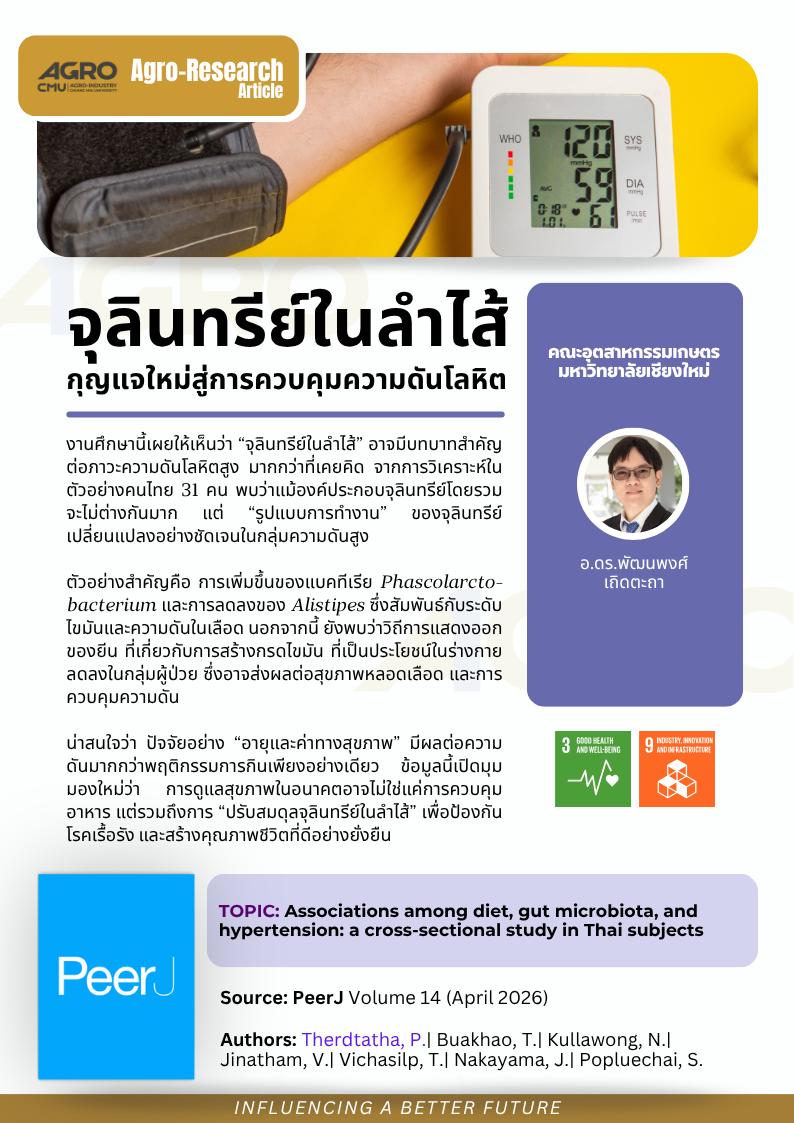
Gut Microbiota: The New Key to Controlling Blood Pressure
Research news
Jun 24, 2026
Author: nutthawat.s@cmu.ac.th
This study highlights a new perspective on hypertension: gut microbes may play a more critical role than previously thought. In a cohort of 31 Thai adults, researchers found that while overall microbial composition showed only subtle differences, the functional activity of the gut ecosystem shifted significantly in individuals with high blood pressure.
Key findings include an increase in Phascolarctobacterium and a decrease in Alistipes, both closely linked to blood lipid levels and blood pressure indicators. Notably, gene expression pathways responsible for beneficial fatty acid production were reduced in the patients, potentially affecting vascular health and blood pressure regulation.
Interestingly, age and clinical health markers had a stronger influence than diet alone. These insights suggest future healthcare innovations may focus on “microbiome-targeted interventions,” offering new ways to prevent chronic diseases and promote long-term human health.
Topic: Associations among diet, gut microbiota, and hypertension: a cross-sectional study in Thai subjects
Authors: Therdtatha, P.| Buakhao, T.| Kullawong, N.| Jinatham, V.| Vichasilp, T.| Nakayama, J.| Popluechai, S.
Abstract:
Background: Although the link between the gut microbiota and hypertension has been investigated, its specific role in the increasing prevalence of this disease in Thailand, influenced by changing dietary patterns, remains unexplored. This cohort study investigated the association between the gut microbiome and hypertension-related dietary habits in Thai subjects.
Methods: The fecal microbiomes of 31 Thai adults, including non-hypertensive (NHT, n = 12) and hypertensive (HT, n = 19) subjects, were grouped and analyzed according to their dietary and medical records. Alpha and beta diversity analyses were performed to determine significant differences (p < 0.05) in microbial diversity between groups. Variations in the microbiome profiles were identified using Linear Discriminant Analysis Effect Size (LEfSe) based on a linear discriminant analysis score > 2.0 (p < 0.05). Multiple Factor Analysis (MFA) was employed to integrate anthropometric data, dietary consumption, and gut microbiome, enabling the visualization of features driving overall variation. Functional profiles of the gut microbiome were predicted using PICRUSt2 based on the Kyoto Encyclopedia of Genes and Genomes (KEGG) categories. Differential abundance and microbial-functional associations were evaluated using ALDEx2 and HAllA, respectively.
Results: Our exploratory analysis suggests that hypertension-related differences are strongly associated with host factors (age and clinical profiles) rather than diet or microbial composition. Key taxonomic signatures of the HT group include the expansion of Phascolarctobacterium and depletion of Alistipes, which relates to anthropometric and blood profiles. Functional analysis revealed a profound restructuring of the gut ecosystem in the HT group, characterized by functional dysbiosis where microbial-functional association patterns shift distinct from changes abundance.
Conclusions: These findings suggest that the gut microbiota’s potential role in hypertension may involve altered interaction dynamics, which may provide a new perspective for targeted interventions in the Thai population.
Source: PeerJ Volume 14 (April 2026)
Keywords: Hypertension; Gut microbiota; Phascolarctobacterium; Alistipes; Cardiovascular diseases
View at publisher: https://pmc.ncbi.nlm.nih.gov/articles/PMC13108461/
Recent News
 Faculty activitiesSep 28, 2026
 Faculty activitiesSep 28, 2026
 Awards and achievementsSep 25, 2026
 Research newsSep 25, 2026
 Faculty activitiesSep 24, 2026