








Enhancing the Value of Longan through Innovative Hurdle Technology
Research news
Jul 3, 2026
Author: nutthawat.s@cmu.ac.th
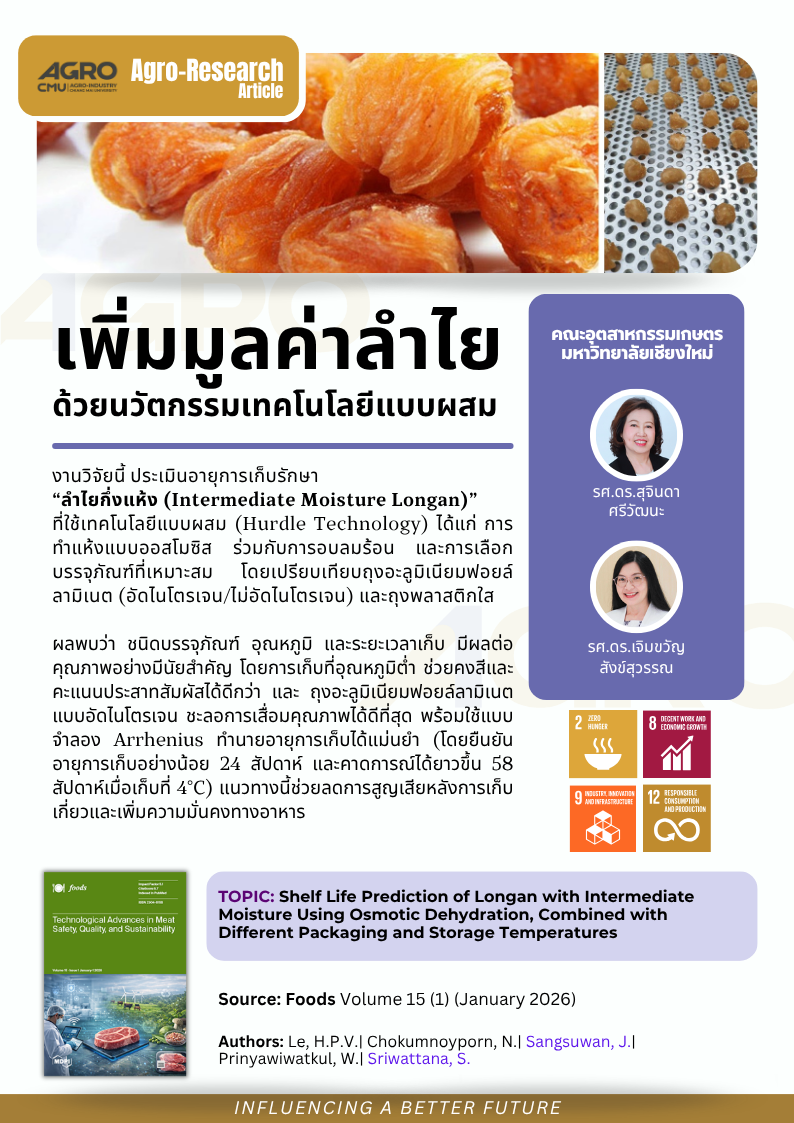
This study evaluated the shelf life of intermediate moisture longan (IML) using a hurdle technology approach combining osmotic dehydration, hot-air drying, and packaging. IML was stored for up to 24 weeks at 4–45°C in three packaging types: aluminum foil–laminated bags with nitrogen flushing, aluminum foil–laminated bags without nitrogen, and clear plastic bags. Results showed that packaging, storage temperature, and storage time significantly affected product quality. Lower temperatures better preserved color and sensory acceptance, and nitrogen-flushed aluminum laminate bags provided the strongest protection with the slowest quality deterioration. An Arrhenius-based accelerated shelf-life model (first-order kinetics) closely matched experimental data and supported reliable shelf-life prediction, confirming at least 24 weeks of stability and indicating longer potential shelf life under refrigeration. This technology can reduce post-harvest losses and support packaging innovation and food security.
Topic: Shelf Life Prediction of Longan with Intermediate Moisture Using Osmotic Dehydration, Combined with Different Packaging and Storage Temperatures
Authors: Le, H.P.V.| Chokumnoyporn, N.| Sangsuwan, J.| Prinyawiwatkul, W.| Sriwattana, S.
Abstract:
This study aimed to evaluate the shelf life of intermediate moisture longan (IML). A hurdle technology approach was applied, combining osmotic dehydration (OD), hot-air drying, and packaging methods: aluminum foil-laminated plastic bags with nitrogen flushing (Al bag with nitrogen), aluminum foil-laminated plastic bags without nitrogen (the Al bag without nitrogen), and clear plastic bags. Samples were stored at 4, 25, 35, and 45 °C for 24 weeks (six months). The combination of these preservation techniques was effective in extending the shelf life of IML products. Quality changes in IML during storage were significantly influenced by packaging type, storage temperature, and storage duration (p ≤ 0.05). Products stored in all three types of packaging at low temperatures retained better color (L* 31.92 ± 0.97–32.67 ± 1.47) and higher sensory scores (6.5 ± 1.4–6.6 ± 1.5) compared to those stored at higher temperatures (L* 19.54 ± 1.00–20.90 ± 1.48, 3.3 ± 1.6–4.1 ± 1.7). Accelerated shelf life testing using the Arrhenius equation was applied to predict changes in color and sensory acceptance. The kinetics of these quality changes followed the first-order reaction models. Among the packaging types, IML stored in Al bags with nitrogen exhibited the lowest rate constants, indicating slower quality deterioration and better protection compared to Al bags without nitrogen and clear plastic bags. The predictive model demonstrated strong agreement with the experimental data, accurately predicting shelf life at 25 °C and above. However, the model projected a potential shelf life of up to 58 weeks for IML samples packaged in aluminum bags with nitrogen and stored at 4 °C; this projection extended beyond the 24-week experimental period, which still verified a minimum shelf life of 24 weeks. This technology reduces post-harvest food loss, advances packaging innovation for agro-industry, and strengthens food security.
Source: Foods Volume 15 (1) (January 2026)
Keywords: fruit preservation; consumer testing; shelf–life prediction; aluminum foil laminated with plastic bag; health and the environment; small-scale farmer productivity
View at publisher: https://www.mdpi.com/2304-8158/15/1/40
Recent News
 Faculty activitiesAug 24, 2026
 Awards and achievementsAug 24, 2026
 Awards and achievementsAug 21, 2026
 Awards and achievementsAug 24, 2026