








Smart Packaging from Nature: A Sustainable Solution to Preserve Food and Reduce Waste
Research news
Jul 7, 2026
Author: nutthawat.s@cmu.ac.th
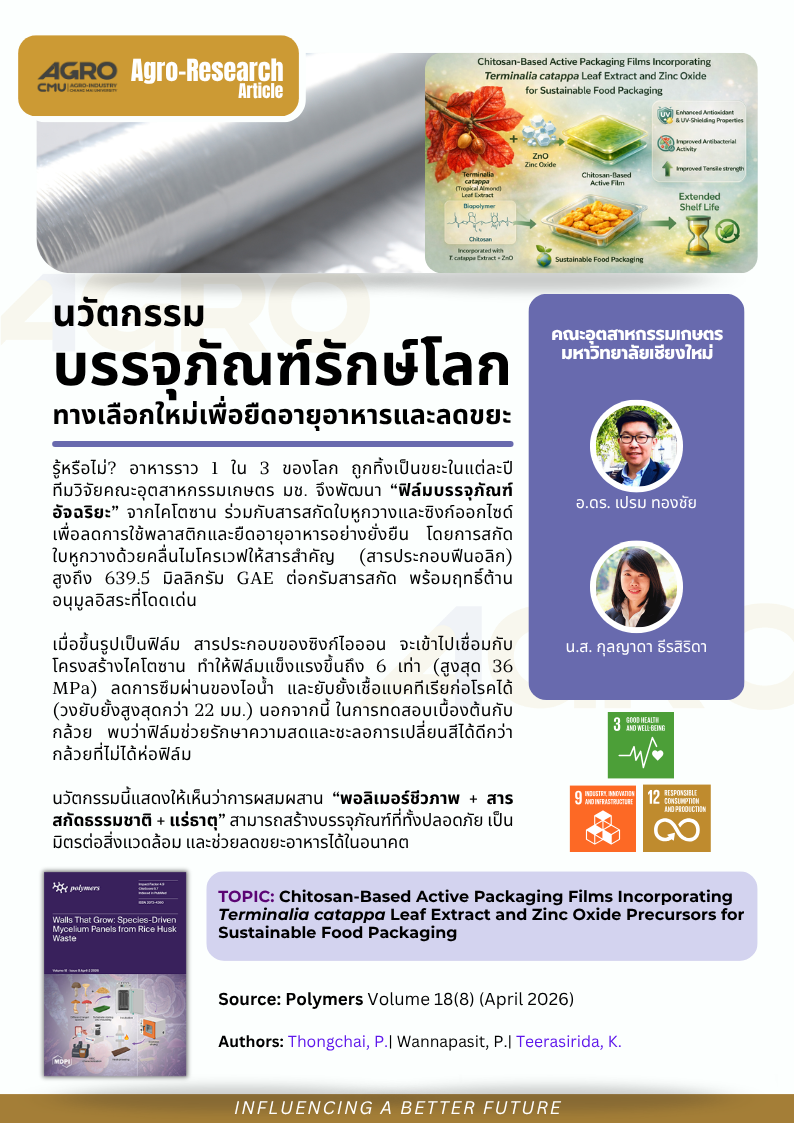
Did you know nearly one-third of the world’s food is wasted every year? Researchers at the Faculty of Agro-Industry, Chiang Mai University, have developed “smart packaging films” from chitosan, combined with Terminalia catappa leaf extract and zinc, as a nature-based way to cut plastic use and sustainably extend food shelf life. Microwave extraction of the leaves yields a high bioactive (phenolic) content—up to 639.5 mg GAE/g extract—with strong antioxidant activity.
During film casting, the zinc bonds with the chitosan network, making the films up to 6× stronger (up to 36 MPa), lowering water-vapor permeability, and inhibiting harmful bacteria (inhibition zones exceeding 22 mm). In a preliminary test, bananas wrapped in the films stayed fresher and browned more slowly than unwrapped ones.
This innovation demonstrates that combining biopolymers, natural extracts, and minerals can create packaging solutions that are safe, environmentally friendly, and capable of reducing food waste in the future.
Topic: Chitosan-Based Active Packaging Films Incorporating Terminalia catappa Leaf Extract and Zinc Oxide Precursors for Sustainable Food Packaging
Authors: Thongchai, P.| Wannapasit, P.| Teerasirida, K.
Abstract:
Chitosan-based active films containing microwave-extracted Terminalia catappa leaf extract (TE) and hydrothermally synthesised zinc oxide were developed and characterised. The selected extraction condition (440 W, 20 min, followed by freeze drying) gave 29.5% extract recovery and a total phenolic content of 639.5 mg GAE/g extract. Structural analyses showed that the original crystalline ZnO phase was no longer detectable after film formation under acidic casting conditions, whereas zinc remained present in the film matrix, indicating acid-mediated dissolution and/or structural transformation during casting. Zinc-containing films exhibited higher tensile strength (up to 36.0 MPa), increased glass transition temperature (up to 122.9 °C), and reduced moisture content and water vapour transmission. TE contributed antioxidant activity and light-shielding properties, with antioxidant capacity reaching 22.1 mg Trolox/g film. Films containing ≥0.2% initial ZnO also showed disc-diffusion antimicrobial activity against Escherichia coli (up to 22.7 mm) and Staphylococcus aureus (up to 20.7 mm). A preliminary 7-day banana-wrapping study further suggested that intermediate formulations containing 0.1–0.2% TE and 0.2–0.3% initial ZnO provided a useful balance among mechanical performance, optical properties, antimicrobial activity, and visual preservation. Overall, zinc–polyphenol–chitosan interactions played an important role in governing film structure and functionality.
Source: Polymers Volume 18(8) (April 2026)
Keywords: Terminalia catappa leaves; microwave-assisted extraction; zinc oxide; hydrothermal synthesis; active packaging; chitosan film; antioxidant activity; antimicrobial packaging
View at publisher: https://www.mdpi.com/2073-4360/18/8/928
Recent News
 Faculty activitiesAug 24, 2026
 Awards and achievementsAug 24, 2026