







Awards and achievements
Sep 16, 2026


Loading...
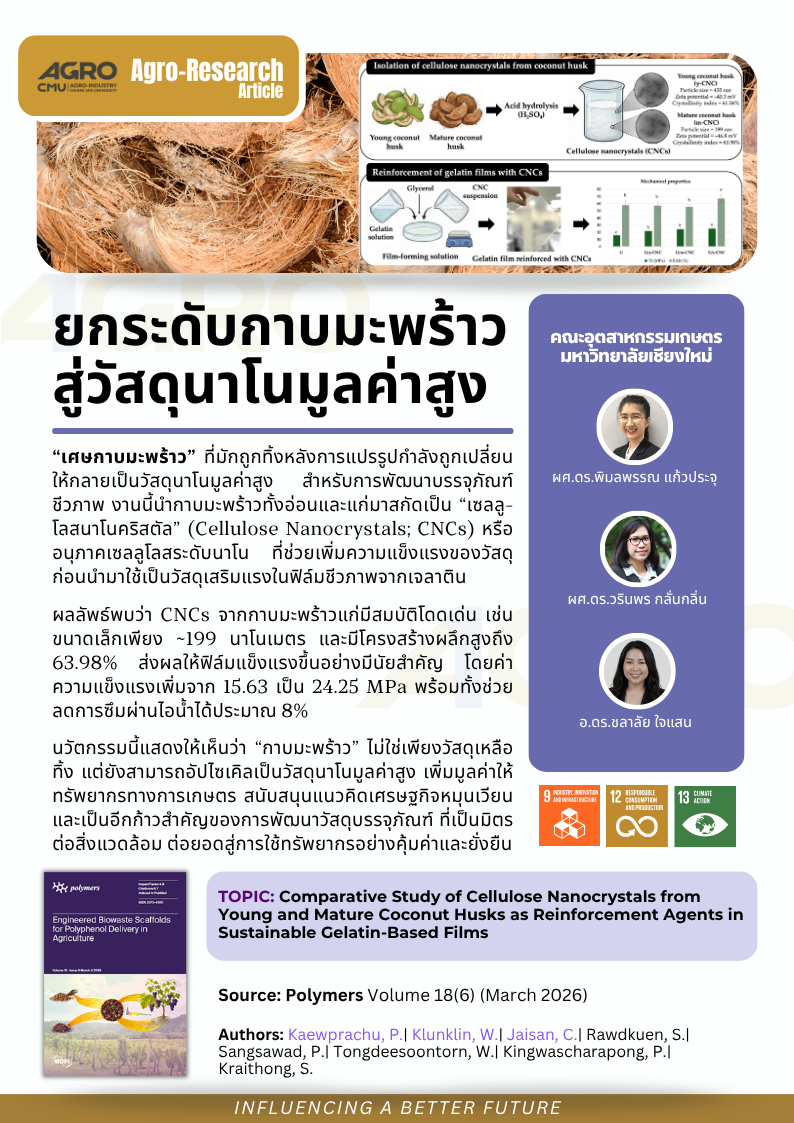
Coconut husk waste—typically discarded after processing—is being transformed into high-value nanomaterials for the development of sustainable biobased packaging. This study converts both young and mature coconut husks into cellulose nanocrystals (CNCs), nanoscale cellulose particles that enhance the mechanical properties of biobased materials. When incorporated into gelatin-based films, CNCs enhanced the film’s properties. Notably, CNCs from mature husks showed superior properties, with a small particle size (~199 nm) and high crystallinity (~63.98%). These characteristics significantly improved the film’s mechanical performance, increasing tensile strength from 15.63 to 24.25 MPa while reducing water vapor permeability by approximately 8%.
This innovation highlights the potential of upcycling coconut husks into high-value nanomaterials, supporting the circular economy and advancing the development of environmentally friendly biobased packaging.
Topic: Comparative Study of Cellulose Nanocrystals from Young and Mature Coconut Husks as Reinforcement Agents in Sustainable Gelatin-Based Films
Authors: Kaewprachu, P.| Klunklin, W.| Jaisan, C.| Rawdkuen, S.| Sangsawad, P.| Tongdeesoontorn, W.| Kingwascharapong, P.| Kraithong, S.
Abstract:
Cellulose nanocrystals (CNCs) are highly desirable nanomaterials for reinforcing biopolymer films. Coconut husks are generated in massive quantities after harvesting and processing, leading to waste management issues. This study isolated and characterized CNCs from young (y-CNCs) and mature (m-CNCs) coconut husks via acid hydrolysis (32% H2SO4, 50 °C, 5 h), comparing them with commercial CNCs (c-CNCs) to evaluate their performance in gelatin-based films. TEM confirmed rod-shaped morphology for all CNCs. Notably, m-CNCs exhibited a smaller particle size (199 nm), a higher surface charge (−46.8 mV), and superior crystallinity (63.98%), demonstrating properties comparable to c-CNCs. FTIR and XRD confirmed characteristic cellulose functional groups and crystalline structure, while TGA demonstrated excellent thermal stability above 300 °C for all samples. Incorporation of CNCs into gelatin films significantly improved tensile strength (from 15.63 to 24.93 MPa) and reduced water vapor permeability (from 2.65 to 2.43 × 10⁻¹⁰ g m m−2 s−1 Pa−1; p < 0.05). These findings demonstrate how coconut husk residues can be upcycled into high-value nanomaterials fostering economic growth with innovation in sustainable manufacturing. This research also promotes responsible waste utilization, highlighting the benefits of biodegradability and a reduced carbon footprint for sustainable food packaging applications.
Source: Polymers Volume 18(6) (March 2026)
Keywords: agricultural waste; biopolymer nanocomposite; circular economy; coconut husk; cellulose nanocrystals; gelatin films; sustainable packaging; waste valorization
View at publisher: https://www.mdpi.com/2073-4360/18/6/708