






กิจกรรมคณะ
16 ก.ย. 2569

Loading...
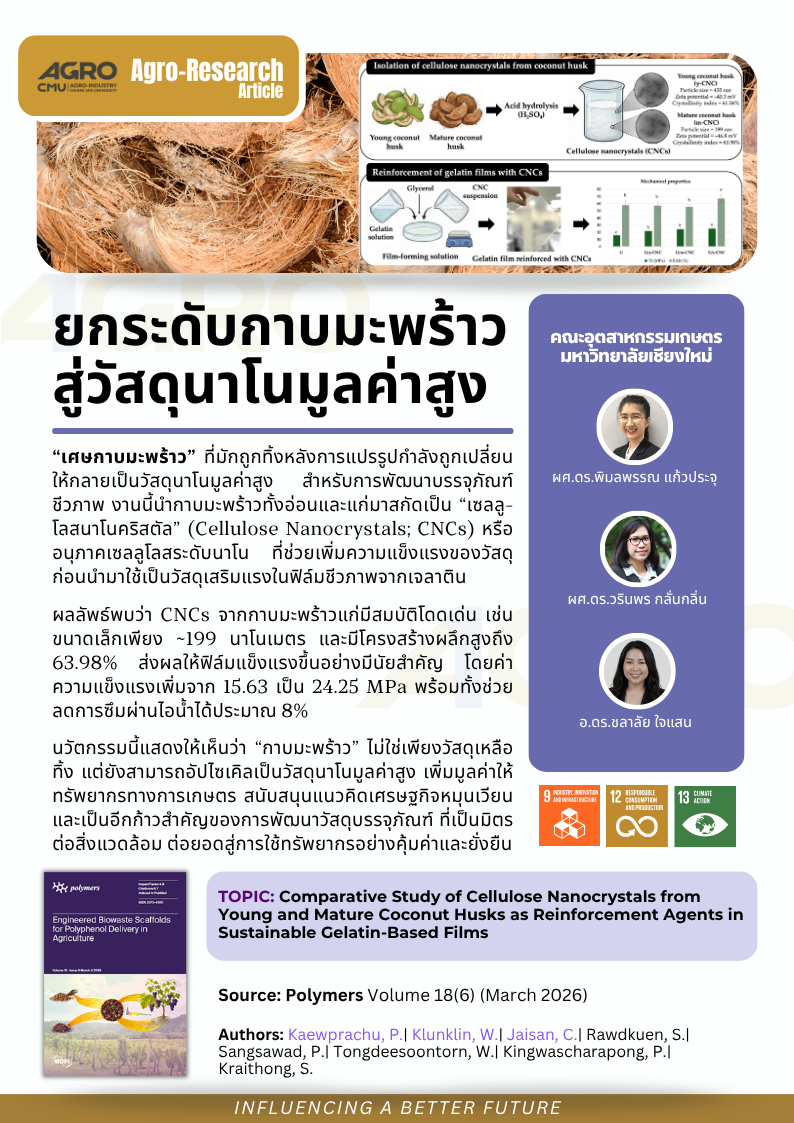
เศษกาบมะพร้าวที่มักถูกทิ้งหลังการแปรรูป กำลังถูกเปลี่ยนให้กลายเป็นวัสดุนาโนมูลค่าสูงสำหรับการพัฒนาบรรจุภัณฑ์ชีวภาพ งานนี้นำกาบมะพร้าวทั้งอ่อนและแก่ มาสกัดเป็น “เซลลูโลสนาโนคริสตัล” (Cellulose Nanocrystals; CNCs) หรืออนุภาคเซลลูโลสระดับนาโนที่ช่วยเพิ่มความแข็งแรงของวัสดุ ก่อนนำมาใช้เป็นวัสดุเสริมแรงในฟิล์มชีวภาพจากเจลาติน ผลลัพธ์พบว่า CNCs จากกาบมะพร้าวแก่มีสมบัติโดดเด่น เช่น ขนาดเล็กเพียง ~199 นาโนเมตร และมีโครงสร้างผลึกสูงถึง 63.98% ส่งผลให้ฟิล์มแข็งแรงขึ้นอย่างมีนัยสำคัญ โดยค่าความแข็งแรงเพิ่มจาก 15.63 เป็น 24.25 MPa พร้อมทั้งช่วยลดการซึมผ่านไอน้ำได้ประมาณ 8%
นวัตกรรมนี้แสดงให้เห็นว่า “กาบมะพร้าว” ไม่ใช่เพียงวัสดุเหลือทิ้ง แต่ยังสามารถอัปไซเคิลเป็นวัสดุนาโนมูลค่าสูง เพิ่มมูลค่าให้ทรัพยากรทางการเกษตร สนับสนุนแนวคิดเศรษฐกิจหมุนเวียน และเป็นอีกก้าวสำคัญของการพัฒนาวัสดุบรรจุภัณฑ์ที่เป็นมิตรต่อสิ่งแวดล้อม ต่อยอดสู่การใช้ทรัพยากรอย่างคุ้มค่าและยั่งยืน
Topic: Comparative Study of Cellulose Nanocrystals from Young and Mature Coconut Husks as Reinforcement Agents in Sustainable Gelatin-Based Films
Authors: Kaewprachu, P.| Klunklin, W.| Jaisan, C.| Rawdkuen, S.| Sangsawad, P.| Tongdeesoontorn, W.| Kingwascharapong, P.| Kraithong, S.
Abstract:
Cellulose nanocrystals (CNCs) are highly desirable nanomaterials for reinforcing biopolymer films. Coconut husks are generated in massive quantities after harvesting and processing, leading to waste management issues. This study isolated and characterized CNCs from young (y-CNCs) and mature (m-CNCs) coconut husks via acid hydrolysis (32% H2SO4, 50 °C, 5 h), comparing them with commercial CNCs (c-CNCs) to evaluate their performance in gelatin-based films. TEM confirmed rod-shaped morphology for all CNCs. Notably, m-CNCs exhibited a smaller particle size (199 nm), a higher surface charge (−46.8 mV), and superior crystallinity (63.98%), demonstrating properties comparable to c-CNCs. FTIR and XRD confirmed characteristic cellulose functional groups and crystalline structure, while TGA demonstrated excellent thermal stability above 300 °C for all samples. Incorporation of CNCs into gelatin films significantly improved tensile strength (from 15.63 to 24.93 MPa) and reduced water vapor permeability (from 2.65 to 2.43 × 10⁻¹⁰ g m m−2 s−1 Pa−1; p < 0.05). These findings demonstrate how coconut husk residues can be upcycled into high-value nanomaterials fostering economic growth with innovation in sustainable manufacturing. This research also promotes responsible waste utilization, highlighting the benefits of biodegradability and a reduced carbon footprint for sustainable food packaging applications.
Source: Polymers Volume 18(6) (March 2026)
Keywords: agricultural waste; biopolymer nanocomposite; circular economy; coconut husk; cellulose nanocrystals; gelatin films; sustainable packaging; waste valorization
View at publisher: https://www.mdpi.com/2073-4360/18/6/708