








Effects of Structural Modification of Okra Polysaccharides on Immuno Enhancing and Antioxidant Activities
Research news
Apr 28, 2026
Author: nutthawat.s@cmu.ac.th
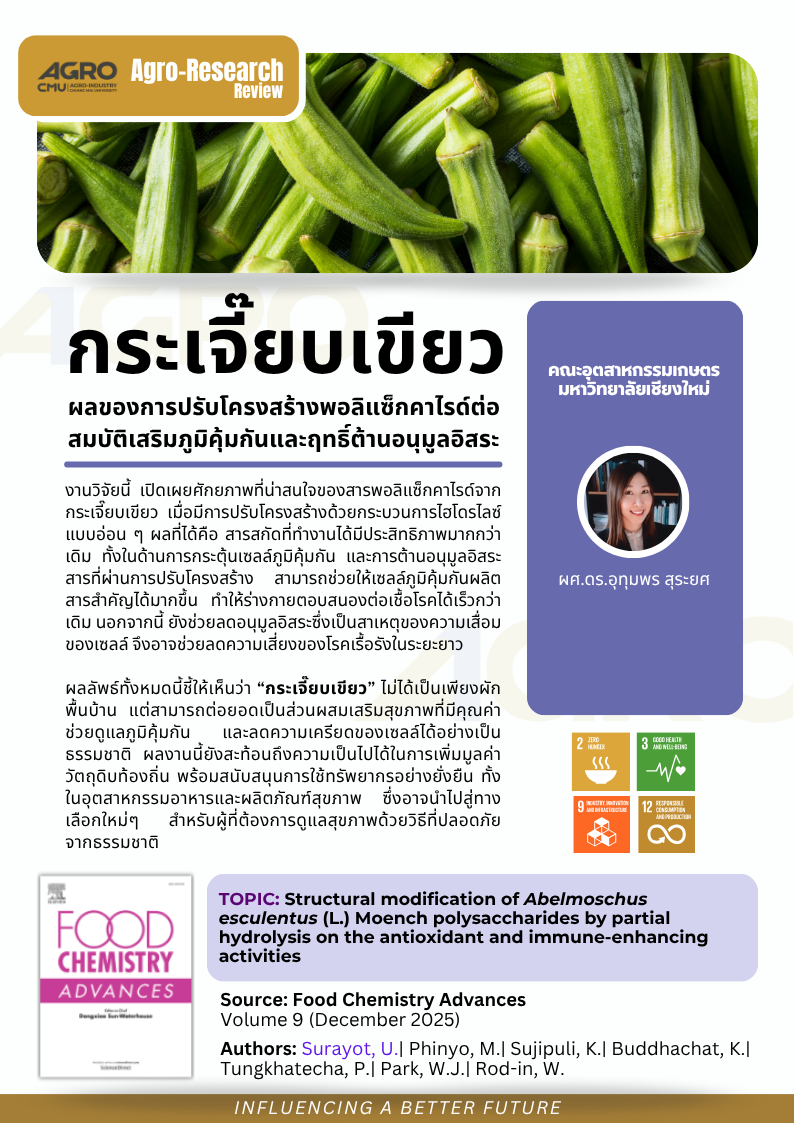
This study highlights the promising potential of okra polysaccharides, especially after their structure is gently modified through mild hydrolysis. The modified extracts showed noticeably stronger effects in supporting the immune system and protecting cells from oxidative damage. They help immune cells become more active and capable of producing key signaling molecules, allowing the body to react more quickly and effectively to harmful microbes. At the same time, the enhanced antioxidant activity helps reduce free radicals, which are linked to long‑term cell degeneration and chronic health conditions.
Altogether, these findings show that okra is more than just a common vegetable—it can be transformed into a valuable natural ingredient that supports immunity and overall well‑being. This work also demonstrates how local agricultural resources can be developed into high‑value functional ingredients that contribute to sustainable production. In the future, improved okra extracts may be used in foods or wellness products that offer an easy and natural way for people to strengthen their health and protect their bodies from everyday stress.
Topic: Structural modification of Abelmoschus esculentus (L.) Moench polysaccharides by partial hydrolysis on the antioxidant and immune-enhancing activities
Authors: Surayot, U.| Phinyo, M.| Sujipuli, K.| Buddhachat, K.| Tungkhatecha, P.| Park, W.J.| Rod-in, W.
Abstract:
In this study, Abelmoschus esculentus (L.) Moench polysaccharides (APs) were prepared by mild acid extraction and ethanol precipitation, followed by purification with ion-exchange chromatography on a DEAE Sepharose Fast Flow column. The crude polysaccharides (AP-Crude) were purified to obtain AP2. The backbone of AP2 mainly consists of (1→4)-linked galactose, (1→4)-linked glucose, (1→2,4)-linked rhamnose, and (1→2)-linked rhamnose residues, with terminal glucose and galactose units. AP2, with an average molecular weight of 182.5 × 10³ g/mol, was further modified by hydrolysis (HS), producing the derivatives AP2-HS1, AP2-HS2, and AP2-HS3, with average molecular weights of 107.2 × 10³, 52.6 × 10³, and 19.8 × 10³ g/mol, respectively. The immune-enhancing effects of AP2 and its derivatives were evaluated, showing significant increases in NO and PGE2 production. Interestingly, AP2-HS1 exhibited greater immune-enhancing potential than the other fractions. AP2-HS1 also upregulated the expression of COX-2, iNOS, TNF-α, IL-1β, and IL-6 by promoting phosphorylation of ERK, JNK, p38, and p65. Additionally, AP2 and its derivatives enhanced radical scavenging activity against DPPH, ABTS⁺, and •OH. These results demonstrate that all polysaccharides possess antioxidant activity and activate macrophages through the MAPK and NF-κB pathways. Overall, partial hydrolysis effectively enhanced the antioxidant and immunomodulatory functions of AP2, with AP2-HS1 showing the strongest potential as a macrophage-activating immunomodulator. The work delivers a functional, food-grade immunomodulator that supports food and nutrition security, sustainable use of agricultural resources, and functional-ingredient development for industrial adoption.
Source: Food Chemistry Advances Volume 9 (December 2025)
Keywords: Abelmoschus esculentu, Polysaccharides, Immunomodulatory, Structural hydrolysis, Bioactive, Agriculture, Noncommunicable diseases
View at publisher: https://www.sciencedirect.com/science/article/pii/S2772753X25002539
Recent News


 Research newsSep 21, 2026