









Cricket Oil as a Next Gen Fat Alternative
Research news
Aug 6, 2026
Author: nutthawat.s@cmu.ac.th
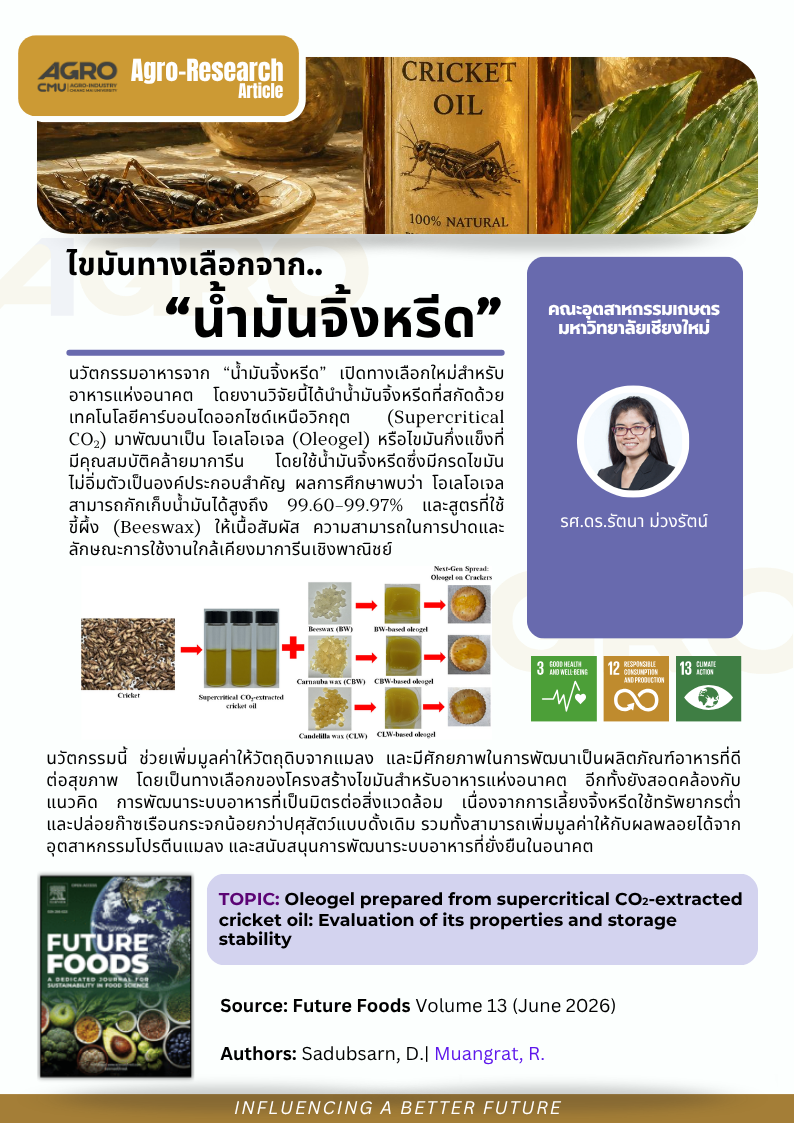
Food innovation from cricket oil is opening new opportunities for the future of sustainable foods. In this study, cricket oil extracted using supercritical carbon dioxide (Supercritical CO2) technology was structured into an oleogel, a semi-solid fat system with margarine-like properties. The oleogel was prepared using cricket oil, which is rich in unsaturated fatty acids. The results showed that the oleogels achieved an oil-binding capacity of 99.60–99.97%, while the formulation structured with beeswax (BW) exhibited desirable texture, excellent spreadability, and handling characteristics comparable to those of commercial margarine.
This innovation adds value to insect-derived raw materials and demonstrates the potential of cricket oil as an alternative fat-structuring ingredient for healthier food products. It also supports the development of environmentally sustainable food systems, as cricket farming requires fewer natural resources and generates lower greenhouse gas emissions than conventional livestock production. Furthermore, the utilization of cricket oil can enhance the value of insect-processing by-products, contributing to more sustainable and circular food production in the future.
Topic: Oleogel prepared from supercritical CO2-extracted cricket oil: Evaluation of its properties and storage stability
Authors: Sadubsarn, D.| Muangrat, R.
Abstract:
Oleogels were prepared from cricket oil extracted under optimal supercritical CO2 (SCCO2) condition (60 °C, 200 bar, 5 h) using 5% (w/w) beeswax (BW), candelilla wax (CLW), and carnauba wax (CBW). The BW-based oleogel exhibited a high oil binding capacity (99.60±0.29%), slightly lower than that of CLW (99.97±0.05%), while showing superior spreadability (0.52±0.13 mJ) and handling characteristics comparable to commercial margarine. Rheological analysis indicated that CLW formed the most rigid and elastic network under low to moderate strain and frequency, whereas CBW, despite lower initial rigidity, exhibited greater thermal stability, with BW showing intermediate behavior. These trends were consistent with differential scanning calorimetry results. Oxidative stability, assessed by peroxide value during storage at 25, 45, and 55 °C, was strongly influenced by temperature. BW-based oleogels showed slightly lower peroxide values at 25 °C, whereas at elevated temperatures, CBW-based oleogels and SCCO2-extracted cricket oil tended to exhibit lower peroxide formation than BW- and CLW-based oleogels. Overall, the type of commercial wax governed the mechanical, thermal, and handling properties of SCCO2-extracted cricket oil oleogels. BW-based oleogel provided an optimal balance of spreadability, texture, and margarine-like characteristics. In contrast, CBW-based oleogel showed enhanced thermal stability and a tendency toward reduced peroxide values at elevated storage temperatures, comparable to supercritical CO2-extracted cricket oil. However, oleogel structuring alone was insufficient to effectively limit lipid oxidation during storage, particularly under elevated temperatures.
Source: Future Foods Volume 13 (June 2026)
Keywords: Oleogels; Beeswax; Candelilla wax; Carnauba wax; Supercritical CO2; Cricket oil
View at publisher: https://www.sciencedirect.com/science/article/pii/S266683352600064X
Recent News


 Research newsSep 21, 2026