









ไขมันทางเลือกจากน้ำมันจิ้งหรีด
วิจัย
6 ส.ค. 2569
ผู้เขียน: nutthawat.s@cmu.ac.th
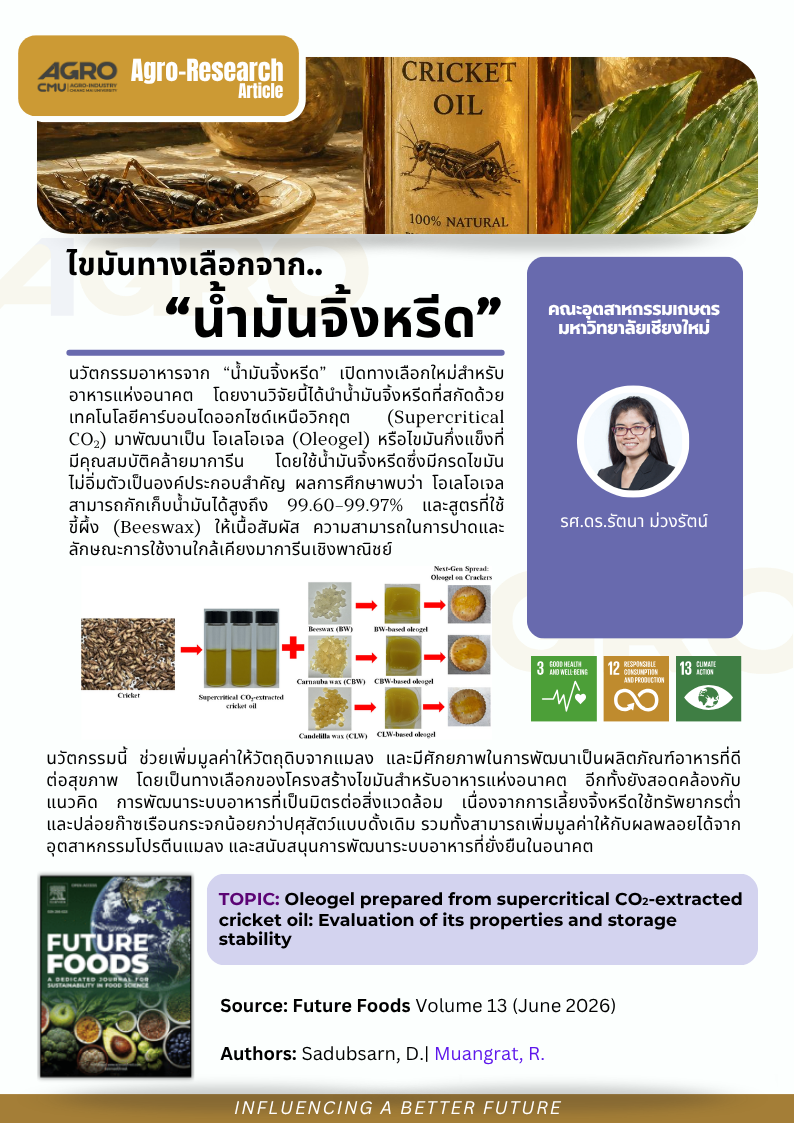
นวัตกรรมอาหารจาก “น้ำมันจิ้งหรีด” เปิดทางเลือกใหม่สำหรับอาหารแห่งอนาคต โดยงานวิจัยนี้ได้นำน้ำมันจิ้งหรีดที่สกัดด้วยเทคโนโลยีคาร์บอนไดออกไซด์เหนือวิกฤต (Supercritical CO2) มาพัฒนาเป็น โอเลโอเจล (Oleogel) หรือไขมันกึ่งแข็งที่มีคุณสมบัติคล้ายมาการีน โดยใช้น้ำมันจิ้งหรีดซึ่งมีกรดไขมันไม่อิ่มตัวเป็นองค์ประกอบสำคัญ ผลการศึกษาพบว่าโอเลโอเจลสามารถกักเก็บน้ำมันได้สูงถึง 99.60–99.97% และสูตรที่ใช้ ขี้ผึ้ง (Beeswax) ให้เนื้อสัมผัส ความสามารถในการปาด และลักษณะการใช้งานใกล้เคียงมาการีนเชิงพาณิชย์
นวัตกรรมนี้ช่วยเพิ่มมูลค่าให้วัตถุดิบจากแมลง และมีศักยภาพในการพัฒนาเป็นผลิตภัณฑ์อาหารที่ดีต่อสุขภาพ โดยเป็นทางเลือกของโครงสร้างไขมันสำหรับอาหารแห่งอนาคต อีกทั้งยังสอดคล้องกับแนวคิดการพัฒนาระบบอาหารที่เป็นมิตรต่อสิ่งแวดล้อม เนื่องจากการเลี้ยงจิ้งหรีดใช้ทรัพยากรต่ำและปล่อยก๊าซเรือนกระจกน้อยกว่าปศุสัตว์แบบดั้งเดิม รวมทั้งสามารถเพิ่มมูลค่าให้กับผลพลอยได้จากอุตสาหกรรมโปรตีนแมลง และสนับสนุนการพัฒนาระบบอาหารที่ยั่งยืนในอนาคต
Topic: Oleogel prepared from supercritical CO2-extracted cricket oil: Evaluation of its properties and storage stability
Authors: Sadubsarn, D.| Muangrat, R.
Abstract:
Oleogels were prepared from cricket oil extracted under optimal supercritical CO2 (SCCO2) condition (60 °C, 200 bar, 5 h) using 5% (w/w) beeswax (BW), candelilla wax (CLW), and carnauba wax (CBW). The BW-based oleogel exhibited a high oil binding capacity (99.60±0.29%), slightly lower than that of CLW (99.97±0.05%), while showing superior spreadability (0.52±0.13 mJ) and handling characteristics comparable to commercial margarine. Rheological analysis indicated that CLW formed the most rigid and elastic network under low to moderate strain and frequency, whereas CBW, despite lower initial rigidity, exhibited greater thermal stability, with BW showing intermediate behavior. These trends were consistent with differential scanning calorimetry results. Oxidative stability, assessed by peroxide value during storage at 25, 45, and 55 °C, was strongly influenced by temperature. BW-based oleogels showed slightly lower peroxide values at 25 °C, whereas at elevated temperatures, CBW-based oleogels and SCCO2-extracted cricket oil tended to exhibit lower peroxide formation than BW- and CLW-based oleogels. Overall, the type of commercial wax governed the mechanical, thermal, and handling properties of SCCO2-extracted cricket oil oleogels. BW-based oleogel provided an optimal balance of spreadability, texture, and margarine-like characteristics. In contrast, CBW-based oleogel showed enhanced thermal stability and a tendency toward reduced peroxide values at elevated storage temperatures, comparable to supercritical CO2-extracted cricket oil. However, oleogel structuring alone was insufficient to effectively limit lipid oxidation during storage, particularly under elevated temperatures.
Source: Future Foods Volume 13 (June 2026)
Keywords: Oleogels; Beeswax; Candelilla wax; Carnauba wax; Supercritical CO2; Cricket oil
View at publisher: https://www.sciencedirect.com/science/article/pii/S266683352600064X
ข่าวล่าสุด


 กิจกรรมคณะ19 ก.ย. 2569