









Influence of Health Behavior and Marketing Strategies on Plant Based Food Acceptance and Consumption
Research news
Mar 4, 2026
Author: nutthawat.s@cmu.ac.th
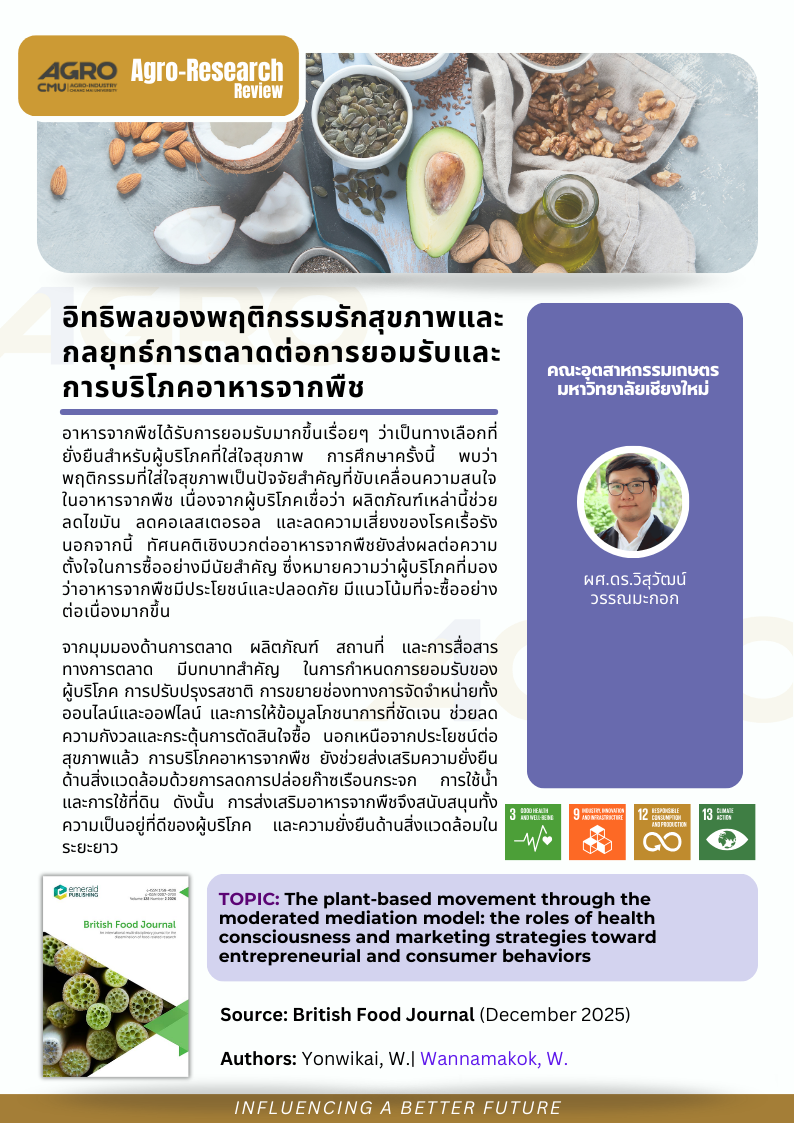
Plant-based foods are increasingly recognized as a sustainable option for health-conscious consumers. This study finds that health-conscious behavior is a key driver of interest in plant-based foods, as consumers believe these products help reduce fat, lower cholesterol, and decrease the risk of chronic diseases. Moreover, a positive attitude toward plant-based foods significantly influences purchase intention, meaning that consumers who perceive them as beneficial and safe are more likely to buy them consistently.
From a marketing perspective, product, place, and marketing communication play crucial roles in shaping consumer acceptance. Improving taste, expanding distribution across online and offline channels, and providing clear nutritional information help reduce concerns and encourage purchase decisions. In addition to health benefits, plant-based food consumption contributes to environmental sustainability by reducing greenhouse gas emissions, water use, and land utilization. Thus, promoting plant-based foods supports both consumer well-being and long-term environmental sustainability.
Topic: The plant-based movement through the moderated mediation model: the roles of health consciousness and marketing strategies toward entrepreneurial and consumer behaviors
Authors: Yonwikai, W.| Wannamakok, W.
Abstract:
Purpose – This study investigates the dynamic interplay between health-conscious behaviors, attitudes toward plant-based foods and consumers’ purchasing decisions, incorporating perspectives from both end consumers and entrepreneurial stakeholders. Through the integration of quantitative analyses derived from structured consumer survey data and qualitative insights obtained from industry practitioners, the research provides a nuanced understanding of the mechanisms through which individual health motivations are translated into behavioral intentions.
Design/methodology/approach – Using a convergent parallel mixed-methods design, quantitative data from 422 consumers were analyzed using partial least squares and Macro Process Model 15. Also, the qualitative insights were gathered from eight plant-based food entrepreneurs for further investigation.
Findings – The study reveals that preventing noncommunicable diseases (NCDs) is a key motivator for plantbased food consumption. Health-conscious behavior significantly influences attitudes and purchase intentions, with attitudes acting as a mediating factor. Product, place and promotional strategies strengthen these relationships, while price has no significant influence on plant-based food products’ purchasing intentions.
Research limitations/implications – This research introduces the theoretical implications of the SAVE framework, which encompasses strategic marketing, attitude shaping, value-driven health positioning and enhancing purchase intention, providing a novel conceptual lens for examining and leveraging health-conscious consumer behavior within the plant-based food market in the nearest future.
Practical implications – The findings offer actionable guidance for marketers and businesses aiming to engage health-conscious consumers, emphasizing the importance of non-price marketing mix elements and attitudeshaping strategies to promote plant-based dietary practices.
Originality/value – This study advances the understanding of the key factors that consumers perceive as determinants of their purchasing intentions toward plant-based food products.
Source: British Food Journal, (December 2025)
Keywords: Convergent parallel mixed method; Healthy behavior; Plant-based food; Marketing strategy; Consumer behavior
View at publisher: https://doi.org/10.1108/BFJ-05-2025-0732
Recent News


 Faculty activitiesAug 24, 2026
 Awards and achievementsAug 24, 2026