








Leaf to Life: Transforming Mature Tea Leaves into a Functional Health Drink
Research news
Jul 13, 2026
Author: nutthawat.s@cmu.ac.th
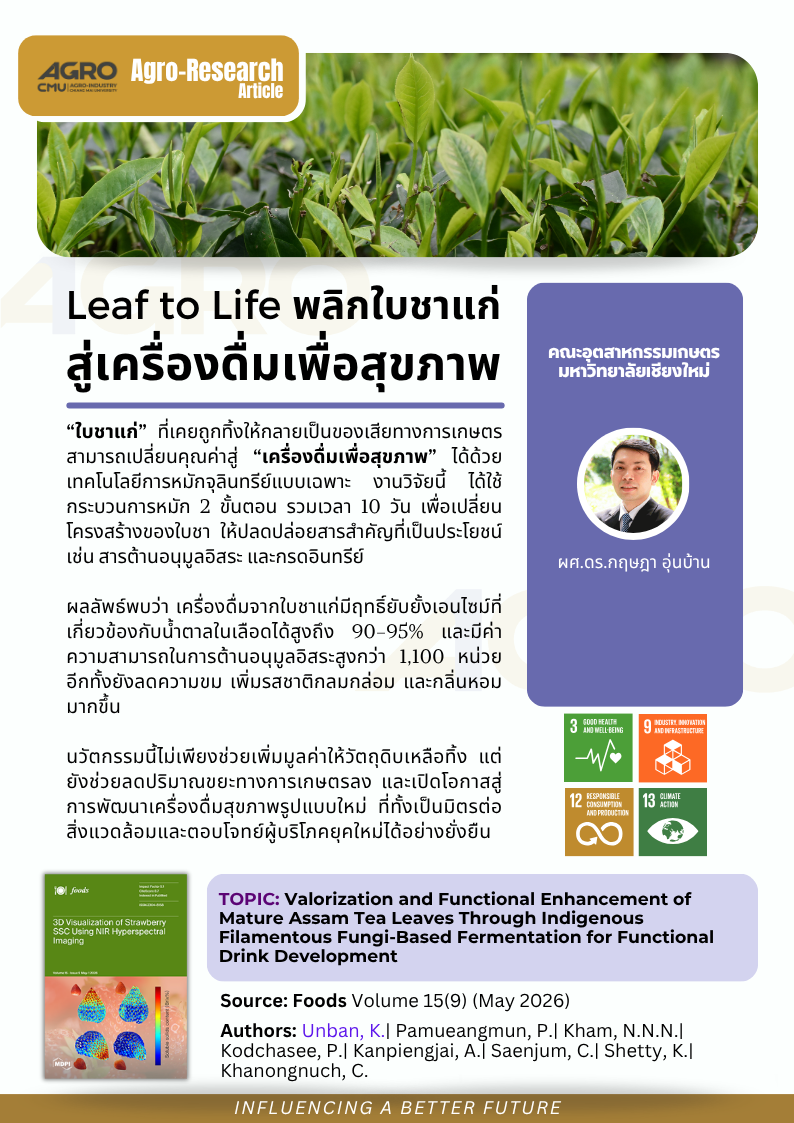
Mature tea leaves, once discarded as agricultural waste, can now be transformed into a high-value functional beverage through an innovative microbial fermentation process. Using a two-step fermentation over 10 days, the structure of tea leaves is broken down, releasing beneficial bioactive compounds such as antioxidants and organic acids.
The results are remarkable: the fermented product shows up to 90–95% inhibition of key enzymes related to blood sugar and delivers antioxidant capacity exceeding 1,100 units. At the same time, bitterness is reduced while flavor and aroma are significantly enhanced.
This innovation not only converts low-value raw materials into health-promoting products but also reduces agricultural waste. It highlights a sustainable pathway for developing next-generation functional drinks that benefit both people and the environment.
Topic: Valorization and Functional Enhancement of Mature Assam Tea Leaves Through Indigenous Filamentous Fungi-Based Fermentation for Functional Drink Development
Authors: Unban, K.| Pamueangmun, P.| Kham, N.N.N.| Kodchasee, P.| Kanpiengjai, A.| Saenjum, C.| Shetty, K.| Khanongnuch, C.
Abstract:
Miang, a traditional fermented tea produced from Camellia sinensis var. assamica, is of notable cultural and socio-economic relevance in Northern Thailand. Traditionally, the non-filamentous fungi-based process (NFP) in western Lanna uses only young tea leaves, resulting in substantial amounts of mature leaves being discarded as agricultural waste. This study aimed to utilize the mature tea leaves by adapting the filamentous fungi growth-based process (FFP) of eastern Lanna using selected tannin-tolerant microorganisms, including Aspergillus niger MLF3, Cyberlindera rhodanensis P3, and Lactiplantibacillus pentosus A14-6. Study on fermentation dynamics and bioactive compound formation based on a 2-step fermentation process: 3-day solid-state fermentation with A. niger MLF3, followed by 7-day submerged fermentation by co-culture of C. rhodaninsis P3, and L. pentosus A14-6 in 500 mL sterile distilled water at 30 °C. Increased activities of polysaccharide-degrading enzymes and organic acids were clearly observed during solid-state fermentation, while the significant changes in polyphenol, antioxidant, and reducing sugar content in cell-free supernatant (CFS) were found after submerged fermentation. The obtained CFS shows inhibitory effects of 90 ± 2.5% and 95 ± 1.8% on α-glucosidase and α-amylase, respectively. Analysis of CFS by E-tongue and E-nose clearly indicated the influence of microbial mixture on the taste and aroma of the fermented products. These results demonstrate not only a high-yielding strategy for the effective biotransformation of mature tea leaves into functional drink products but also significant implications for reducing agricultural waste.
Source: Foods Volume 15(9) (May 2026)
Keywords: fermented tea leaves; filamentous fungi growth-based process; bioactive compound; mature tea leaves; functional drink
View at publisher: https://www.mdpi.com/2304-8158/15/9/1562
Recent News
 Awards and achievementsAug 28, 2026
 Awards and achievementsAug 27, 2026
 Research newsAug 27, 2026
 Awards and achievementsAug 27, 2026