







ประกวดราคา
28 ส.ค. 2569

Loading...
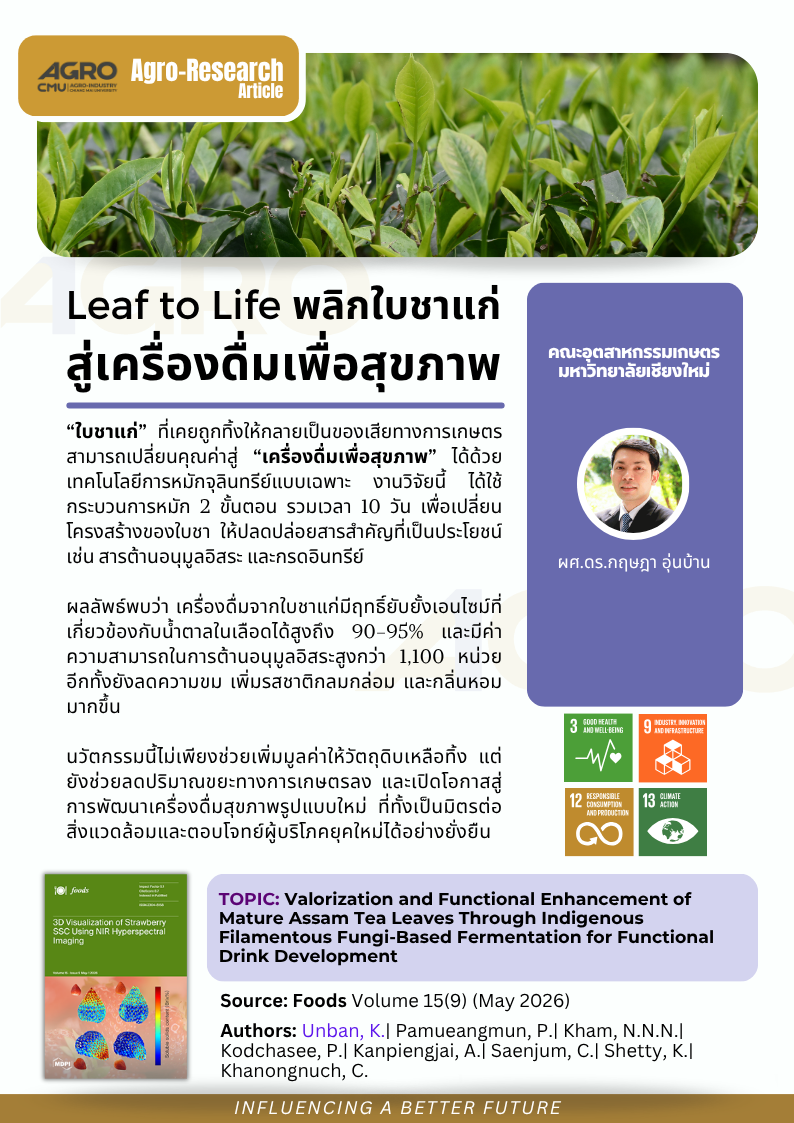
ใบชาแก่ที่เคยถูกทิ้งให้กลายเป็นของเสียทางการเกษตร สามารถ “เปลี่ยนคุณค่า” สู่เครื่องดื่มเพื่อสุขภาพได้ ด้วยเทคโนโลยีการหมักจุลินทรีย์แบบเฉพาะ งานนี้ใช้กระบวนการหมัก 2 ขั้นตอน รวมเวลา 10 วัน เพื่อเปลี่ยนโครงสร้างของใบชาให้ปลดปล่อยสารสำคัญที่เป็นประโยชน์ เช่น สารต้านอนุมูลอิสระและกรดอินทรีย์
ผลลัพธ์พบว่าเครื่องดื่มจากใบชาแก่มีฤทธิ์ยับยั้งเอนไซม์ที่เกี่ยวข้องกับน้ำตาลในเลือดได้สูงถึง 90–95% และมีค่าความสามารถในการต้านอนุมูลอิสระสูงถึงกว่า 1,100 หน่วย อีกทั้งยังลดความขม เพิ่มรสชาติกลมกล่อมและกลิ่นหอมมากขึ้น
นวัตกรรมนี้ไม่เพียงช่วยเพิ่มมูลค่าให้วัตถุดิบเหลือทิ้ง แต่ยังช่วยลดปริมาณขยะทางการเกษตร และเปิดโอกาสสู่การพัฒนาเครื่องดื่มสุขภาพรูปแบบใหม่ที่เป็นมิตรต่อสิ่งแวดล้อมและตอบโจทย์ผู้บริโภคยุคใหม่ได้อย่างยั่งยืน
Topic: Valorization and Functional Enhancement of Mature Assam Tea Leaves Through Indigenous Filamentous Fungi-Based Fermentation for Functional Drink Development
Authors: Unban, K.| Pamueangmun, P.| Kham, N.N.N.| Kodchasee, P.| Kanpiengjai, A.| Saenjum, C.| Shetty, K.| Khanongnuch, C.
Abstract:
Miang, a traditional fermented tea produced from Camellia sinensis var. assamica, is of notable cultural and socio-economic relevance in Northern Thailand. Traditionally, the non-filamentous fungi-based process (NFP) in western Lanna uses only young tea leaves, resulting in substantial amounts of mature leaves being discarded as agricultural waste. This study aimed to utilize the mature tea leaves by adapting the filamentous fungi growth-based process (FFP) of eastern Lanna using selected tannin-tolerant microorganisms, including Aspergillus niger MLF3, Cyberlindera rhodanensis P3, and Lactiplantibacillus pentosus A14-6. Study on fermentation dynamics and bioactive compound formation based on a 2-step fermentation process: 3-day solid-state fermentation with A. niger MLF3, followed by 7-day submerged fermentation by co-culture of C. rhodaninsis P3, and L. pentosus A14-6 in 500 mL sterile distilled water at 30 °C. Increased activities of polysaccharide-degrading enzymes and organic acids were clearly observed during solid-state fermentation, while the significant changes in polyphenol, antioxidant, and reducing sugar content in cell-free supernatant (CFS) were found after submerged fermentation. The obtained CFS shows inhibitory effects of 90 ± 2.5% and 95 ± 1.8% on α-glucosidase and α-amylase, respectively. Analysis of CFS by E-tongue and E-nose clearly indicated the influence of microbial mixture on the taste and aroma of the fermented products. These results demonstrate not only a high-yielding strategy for the effective biotransformation of mature tea leaves into functional drink products but also significant implications for reducing agricultural waste.
Source: Foods Volume 15(9) (May 2026)
Keywords: fermented tea leaves; filamentous fungi growth-based process; bioactive compound; mature tea leaves; functional drink
View at publisher: https://www.mdpi.com/2304-8158/15/9/1562