







Faculty activities
Sep 9, 2026


Loading...
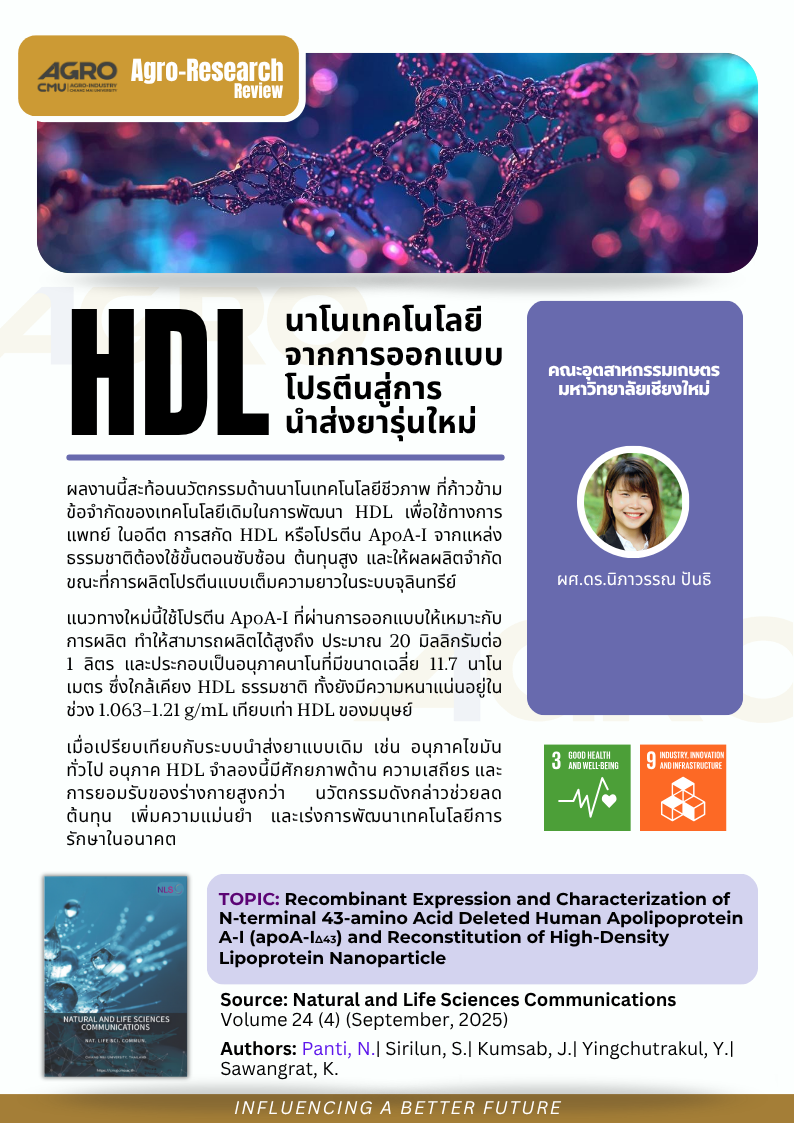
This work represents a bio‑nanotechnology innovation that overcomes key limitations of conventional HDL‑based technologies. Traditionally, HDL or ApoA‑I has been isolated from natural sources through complex, costly processes with limited yield, while full‑length recombinant ApoA‑I often suffers from low productivity and instability.
In contrast, this approach employs a rationally designed ApoA‑I variant optimized for production, achieving yields of approximately 20 mg per liter of culture. The protein self‑assembles into stable HDL‑like nanoparticles with an average diameter of 11.7 nm and a density within the natural HDL range (1.063–1.21 g/mL), closely mimicking human HDL.
Compared with conventional lipid nanoparticles or non‑specific drug carriers, these HDL‑mimetic nanoparticles offer superior biocompatibility, structural stability, and targeting potential. This innovation reduces production barriers, enhances scalability, and accelerates the development of next‑generation drug delivery systems for cardiovascular and inflammatory diseases, supporting more precise and efficient healthcare solutions.
Topic: Recombinant Expression and Characterization of N-terminal 43-amino Acid Deleted Human Apolipoprotein A-I (apoA-IΔ43) and Reconstitution of High-Density Lipoprotein Nanoparticle
Authors: Panti, N.| Sirilun, S.| Kumsab, J.| Yingchutrakul, Y.| Sawangrat, K.
Abstract:
High-density lipoproteins (HDL) play crucial roles in cholesterol homeostasis and have emerged as promising therapeutic targets and drug delivery vehicles. This study developed an optimized protocol for recombinant expression of N-terminal 43-amino acid deleted human apolipoprotein A-I (apoA-I∆43) in Escherichia coli BL21(DE3) and subsequent reconstitution of HDL-mimetic nanoparticles. Expression optimization revealed that an induction temperature of 37°C, a 3-hour duration, and IPTG concentration of 0.1 mM yielded the highest apoA-I∆43 expression level (~20 mg/L culture). The purified apoA-I∆43 was characterized by LC-MS/MS, confirming a 185-amino acids of the expected 265-amino acid sequence. Reconstituted HDL-mimetic (rHDL) nanoparticles were successfully prepared using apoA-I∆43 and distearoyl-phosphatidylcholine (DSPC). These rHDL nanoparticles exhibited HDL-specific characteristics such as density (1.063-1.21 g/mL) and hydrodynamic diameter (11.7 ± 3.4 nm). This protocol provides a reliable platform for producing apoA-I∆43 for pharmaceutical applications and drug delivery system development.
Source: Natural and Life Sciences Communications Volume 24 (4) (September, 2025)
Keywords: Apolipoprotein A-I, Recombinant expression, High-density lipoprotein, Nanoparticles, Drug delivery vehicles
View at publisher: https://cmuj.cmu.ac.th/nlsc/journal/article/1170