







เปลี่ยนกากจิ้งหรีดให้เป็นไคตินคุณภาพสูง ก้าวใหม่ของวัสดุชีวภาพที่ยั่งยืน
วิจัย
1 เม.ย. 2569
ผู้เขียน: nutthawat.s@cmu.ac.th
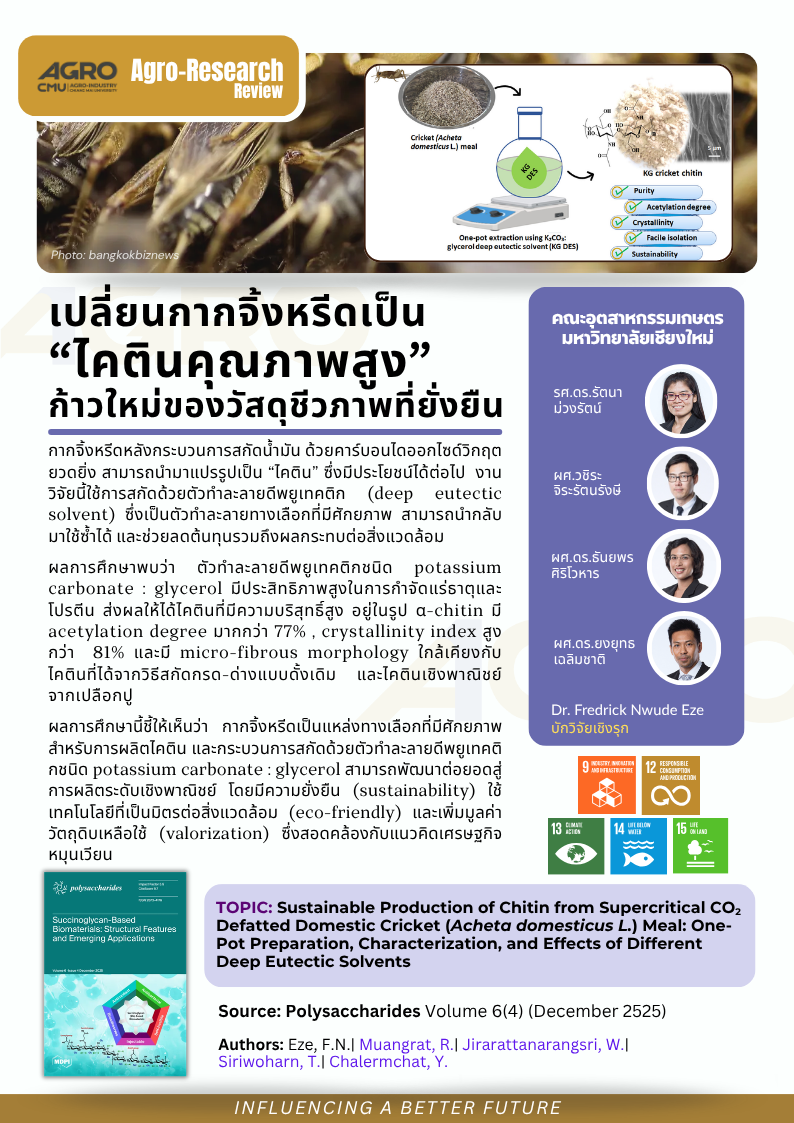
กากจิ้งหรีดหลังกระบวนการสกัดน้ำมันด้วยคาร์บอนไดออกไซด์วิกฤตยวดยิ่งสามารถนำมาแปรรูปเป็น “ไคติน” ซึ่งมีประโยชน์ได้ต่อไป งานวิจัยนี้ใช้การสกัดด้วยตัวทำละลายดีพยูเทคติก (deep eutectic solvent) ซึ่งเป็นตัวทำละลายทางเลือกที่มีศักยภาพ สามารถนำกลับมาใช้ซ้ำได้ และช่วยลดต้นทุนรวมถึงผลกระทบต่อสิ่งแวดล้อม
ผลการศึกษาพบว่าตัวทำละลายดีพยูเทคติกชนิด potassium carbonate : glycerol มีประสิทธิภาพสูงในการกำจัดแร่ธาตุและโปรตีน ส่งผลให้ได้ไคตินที่มีความบริสุทธิ์สูง อยู่ในรูป α-chitin มี acetylation degree มากกว่า 77% , crystallinity index สูงกว่า 81% และมี micro-fibrous morphology ใกล้เคียงกับไคตินที่ได้จากวิธีสกัดกรด-ด่างแบบดั้งเดิมและไคตินเชิงพาณิชย์จากเปลือกปู
ผลการศึกษานี้ชี้ให้เห็นว่ากากจิ้งหรีดเป็นแหล่งทางเลือกที่มีศักยภาพสำหรับการผลิตไคติน และกระบวนการสกัดด้วยตัวทำละลายดีพยูเทคติกชนิด potassium carbonate : glycerol สามารถพัฒนาต่อยอดสู่การผลิตระดับเชิงพาณิชย์ โดยมีความยั่งยืน (sustainability) ใช้เทคโนโลยีที่เป็นมิตรต่อสิ่งแวดล้อม (eco-friendly) และเพิ่มมูลค่าวัตถุดิบเหลือใช้ (valorization) ซึ่งสอดคล้องกับแนวคิดเศรษฐกิจหมุนเวียน
Topic: Sustainable Production of Chitin from Supercritical CO2 Defatted Domestic Cricket (Acheta domesticus L.) Meal: One-Pot Preparation, Characterization, and Effects of Different Deep Eutectic Solvents
Authors: Eze, F.N.| Muangrat, R.| Jirarattanarangsri, W.| Siriwoharn, T.| Chalermchat, Y.
Abstract:
Current resource and processing constraints on conventional chitin production call for novel sources and more sustainable methods for its production. Herein, domestic cricket (Acheta domesticus L.) meal obtained from supercritical CO2 oil extraction was investigated as a viable source of chitin via a one-pot approach using acidic (choline chloride: glycerol, CCG) and alkaline (potassium carbonate: glycerol, KG) deep eutectic solvents (DESs). The chitin samples obtained were compared with those obtained using conventional acid-alkaline extraction (CE) and commercial crab shell chitin (CS chitin) by robust characterization of their composition and physicochemical properties employing color, FTIR, XRD, XPS, and SEM analysis. The results showed that KG DES and recovered KG DES exhibited high demineralization and deproteinization capacity, producing chitin with high purity, α-chitin form, high acetylation degree (>77%), crystallinity (crystallinity index > 81%), and micro-fibrous morphology closely similar to those of CE chitin and CS chitin. Whereas CCG DES demonstrated excellent demineralization, it was less effective at deproteinization, leading to chitin with lower purity and crystalline properties. Together, the results demonstrated that cricket meal could be an alternative source of chitin, while KG DES one-pot extraction holds strong potential as a sustainable and eco-friendly approach for obtaining commercial-grade chitin.
Source: Polysaccharides Volume 6(4) (December 2525)
Keywords: Acheta domesticus L.; sustainable chitin recovery; deep eutectic solvent extraction; insect chitin
View at publisher: https://www.mdpi.com/2673-4176/6/4/115