







กิจกรรมคณะ
24 ก.ย. 2569

Loading...
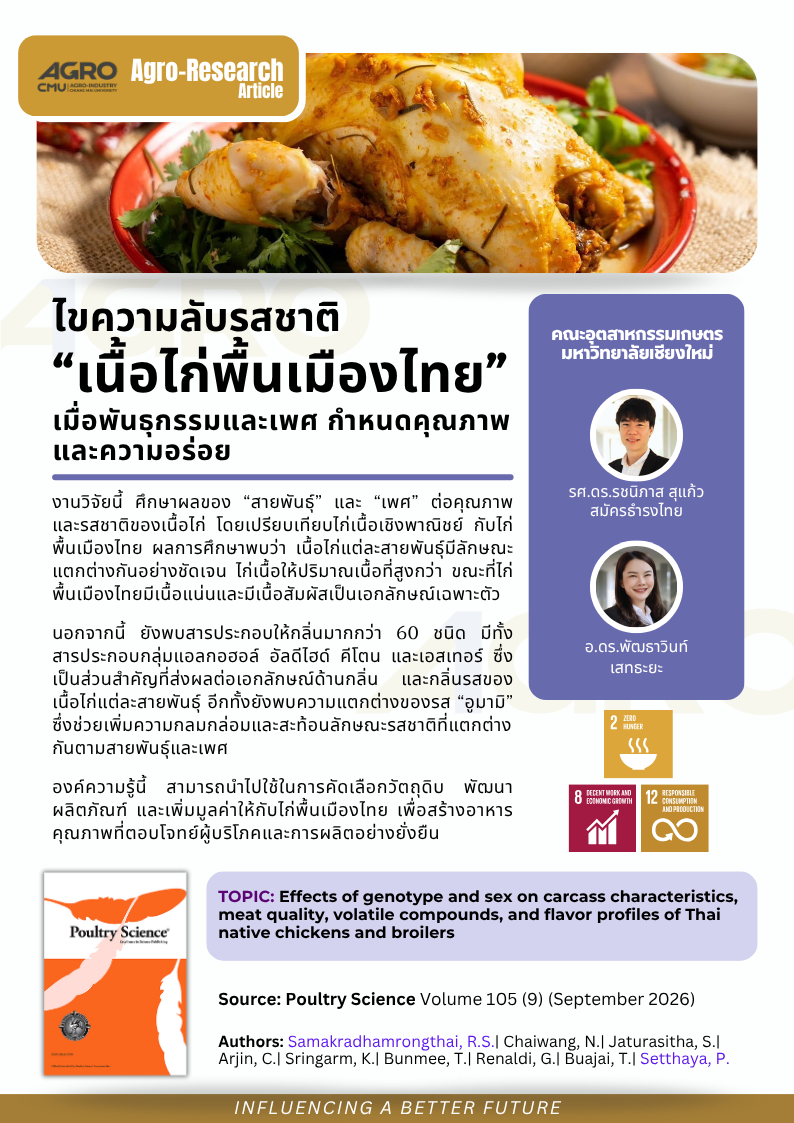
งานวิจัยนี้ศึกษาผลของ “สายพันธุ์” และ “เพศ” ต่อคุณภาพและรสชาติของเนื้อไก่ โดยเปรียบเทียบไก่เนื้อเชิงพาณิชย์กับไก่พื้นเมืองไทย ผลการศึกษาพบว่า เนื้อไก่แต่ละสายพันธุ์มีลักษณะแตกต่างกันอย่างชัดเจน ไก่เนื้อให้ปริมาณเนื้อที่สูงกว่า ขณะที่ไก่พื้นเมืองไทยมีเนื้อแน่นและมีเนื้อสัมผัสเป็นเอกลักษณ์เฉพาะตัว
นอกจากนี้ ยังพบสารประกอบให้กลิ่นมากกว่า 60 ชนิด มีทั้งสารประกอบกลุ่มแอลกอฮอล์ อัลดีไฮด์ คีโตน และเอสเทอร์ ซึ่งเป็นส่วนสำคัญที่ส่งผลต่อเอกลักษณ์ด้านกลิ่นและกลิ่นรสของเนื้อไก่แต่ละสายพันธุ์ อีกทั้งยังพบความแตกต่างของรส “อูมามิ” ซึ่งช่วยเพิ่มความกลมกล่อมและสะท้อนลักษณะรสชาติที่แตกต่างกันตามสายพันธุ์และเพศ
องค์ความรู้นี้สามารถนำไปใช้ในการคัดเลือกวัตถุดิบ พัฒนาผลิตภัณฑ์ และเพิ่มมูลค่าให้กับไก่พื้นเมืองไทย เพื่อสร้างอาหารคุณภาพที่ตอบโจทย์ผู้บริโภคและการผลิตอย่างยั่งยืน
Topic: Effects of genotype and sex on carcass characteristics, meat quality, volatile compounds, and flavor profiles of Thai native chickens and broilers
Authors: Samakradhamrongthai, R.S.| Chaiwang, N.| Jaturasitha, S.| Arjin, C.| Sringarm, K.| Bunmee, T.| Renaldi, G.| Buajai, T.| Setthaya, P.
Abstract:
Chicken meat is widely consumed worldwide due to its versatility and nutritional value. This study evaluated the effects of genotype and sex on carcass characteristics, physicochemical properties, volatile organic compounds (VOCs), and flavor profiles of chicken meat from commercial broilers (CB) and two Thai native breeds, Pradu Hang Dam (PDHD) and Mae Hong Son (MHS). Carcass percentage did not differ among groups; however, genotype and sex significantly influenced carcass yield and organ development, with CB exhibiting superior growth performance. Physicochemical traits varied by muscle and genotype, with thigh muscle showing higher pH and greater tenderness, while native breeds produced darker meat. VOC analysis revealed distinct profiles among genotype–sex groups. MHS females were associated with butanoic acid and butan-2-one, contributing to buttery and cheesy notes, whereas MHS males were characterized by aldehydes, alcohols, and diketones, including trans-4,5-epoxy-(E)-2-enal, 1-hexen-3-ol, and butane-2,3‑dione. In CB group, female breast muscle showed higher levels of Maillard-derived compounds such as furfural and 3-furanthiol, while PDHD samples were associated with ester compounds, particularly methyl dodecanoate. Principal component analysis clearly separated groups, indicating that genotype and sex influence VOC formation through lipid oxidation and amino acid metabolism. Overall, genotype and sex play key roles in shaping meat quality and flavor-related chemical profiles, with implications for breeding and value-added product development.
Source: Poultry Science Volume 105 (9) (September 2026)
Keywords: Thai native chickens; Carcass traits; Meat quality; Volatile compounds; Flavor profile
View at publisher:
https://www.sciencedirect.com/science/article/pii/S003257912600773X?via%3Dihub