






ประกวดราคา
25 ส.ค. 2569

Loading...
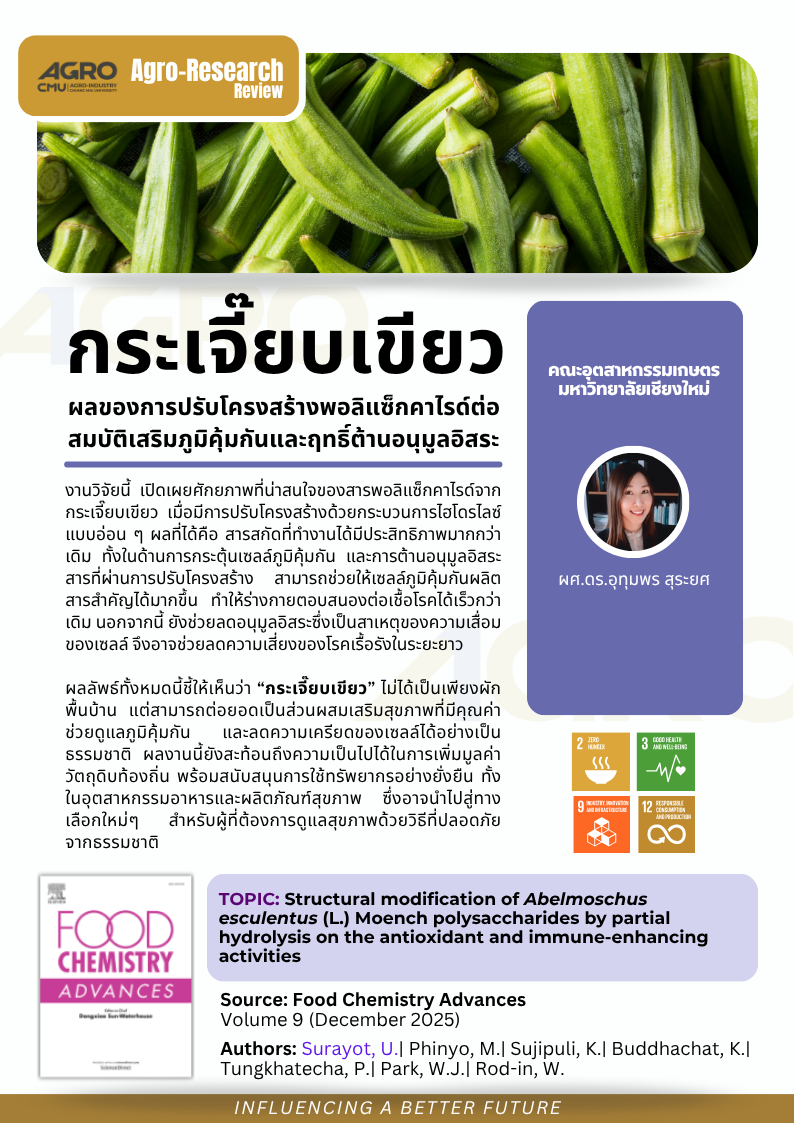
งานวิจัยนี้เปิดเผยศักยภาพที่น่าสนใจของสารพอลิแซ็กคาไรด์จากกระเจี๊ยบเขียว เมื่อมีการปรับโครงสร้างด้วยกระบวนการไฮโดรไลซ์แบบอ่อนๆ ผลที่ได้คือสารสกัดที่ทำงานได้มีประสิทธิภาพมากกว่าเดิม ทั้งในด้านการกระตุ้นเซลล์ภูมิคุ้มกันและการต้านอนุมูลอิสระ สารที่ผ่านการปรับโครงสร้างสามารถช่วยให้เซลล์ภูมิคุ้มกันผลิตสารสำคัญได้มากขึ้น ทำให้ร่างกายตอบสนองต่อเชื้อโรคได้เร็วกว่าเดิม นอกจากนี้ยังช่วยลดอนุมูลอิสระซึ่งเป็นสาเหตุของความเสื่อมของเซลล์ จึงอาจช่วยลดความเสี่ยงของโรคเรื้อรังในระยะยาว
ผลลัพธ์ทั้งหมดนี้ชี้ให้เห็นว่ากระเจี๊ยบเขียวไม่ได้เป็นเพียงผักพื้นบ้าน แต่สามารถต่อยอดเป็นส่วนผสมเสริมสุขภาพที่มีคุณค่า ช่วยดูแลภูมิคุ้มกันและลดความเครียดของเซลล์ได้อย่างเป็นธรรมชาติ งานนี้ยังสะท้อนถึงความเป็นไปได้ในการเพิ่มมูลค่าวัตถุดิบท้องถิ่น พร้อมสนับสนุนการใช้ทรัพยากรอย่างยั่งยืน ทั้งในอุตสาหกรรมอาหารและผลิตภัณฑ์สุขภาพ ซึ่งอาจนำไปสู่ทางเลือกใหม่ ๆ สำหรับผู้ที่ต้องการดูแลสุขภาพด้วยวิธีที่ปลอดภัยจากธรรมชาติ
Topic: Structural modification of Abelmoschus esculentus (L.) Moench polysaccharides by partial hydrolysis on the antioxidant and immune-enhancing activities
Authors: Surayot, U.| Phinyo, M.| Sujipuli, K.| Buddhachat, K.| Tungkhatecha, P.| Park, W.J.| Rod-in, W.
Abstract:
In this study, Abelmoschus esculentus (L.) Moench polysaccharides (APs) were prepared by mild acid extraction and ethanol precipitation, followed by purification with ion-exchange chromatography on a DEAE Sepharose Fast Flow column. The crude polysaccharides (AP-Crude) were purified to obtain AP2. The backbone of AP2 mainly consists of (1→4)-linked galactose, (1→4)-linked glucose, (1→2,4)-linked rhamnose, and (1→2)-linked rhamnose residues, with terminal glucose and galactose units. AP2, with an average molecular weight of 182.5 × 10³ g/mol, was further modified by hydrolysis (HS), producing the derivatives AP2-HS1, AP2-HS2, and AP2-HS3, with average molecular weights of 107.2 × 10³, 52.6 × 10³, and 19.8 × 10³ g/mol, respectively. The immune-enhancing effects of AP2 and its derivatives were evaluated, showing significant increases in NO and PGE2 production. Interestingly, AP2-HS1 exhibited greater immune-enhancing potential than the other fractions. AP2-HS1 also upregulated the expression of COX-2, iNOS, TNF-α, IL-1β, and IL-6 by promoting phosphorylation of ERK, JNK, p38, and p65. Additionally, AP2 and its derivatives enhanced radical scavenging activity against DPPH, ABTS⁺, and •OH. These results demonstrate that all polysaccharides possess antioxidant activity and activate macrophages through the MAPK and NF-κB pathways. Overall, partial hydrolysis effectively enhanced the antioxidant and immunomodulatory functions of AP2, with AP2-HS1 showing the strongest potential as a macrophage-activating immunomodulator. The work delivers a functional, food-grade immunomodulator that supports food and nutrition security, sustainable use of agricultural resources, and functional-ingredient development for industrial adoption.
Source: Food Chemistry Advances Volume 9 (December 2025)
Keywords: Abelmoschus esculentu, Polysaccharides, Immunomodulatory, Structural hydrolysis, Bioactive, Agriculture, Noncommunicable diseases
View at publisher: https://www.sciencedirect.com/science/article/pii/S2772753X25002539