

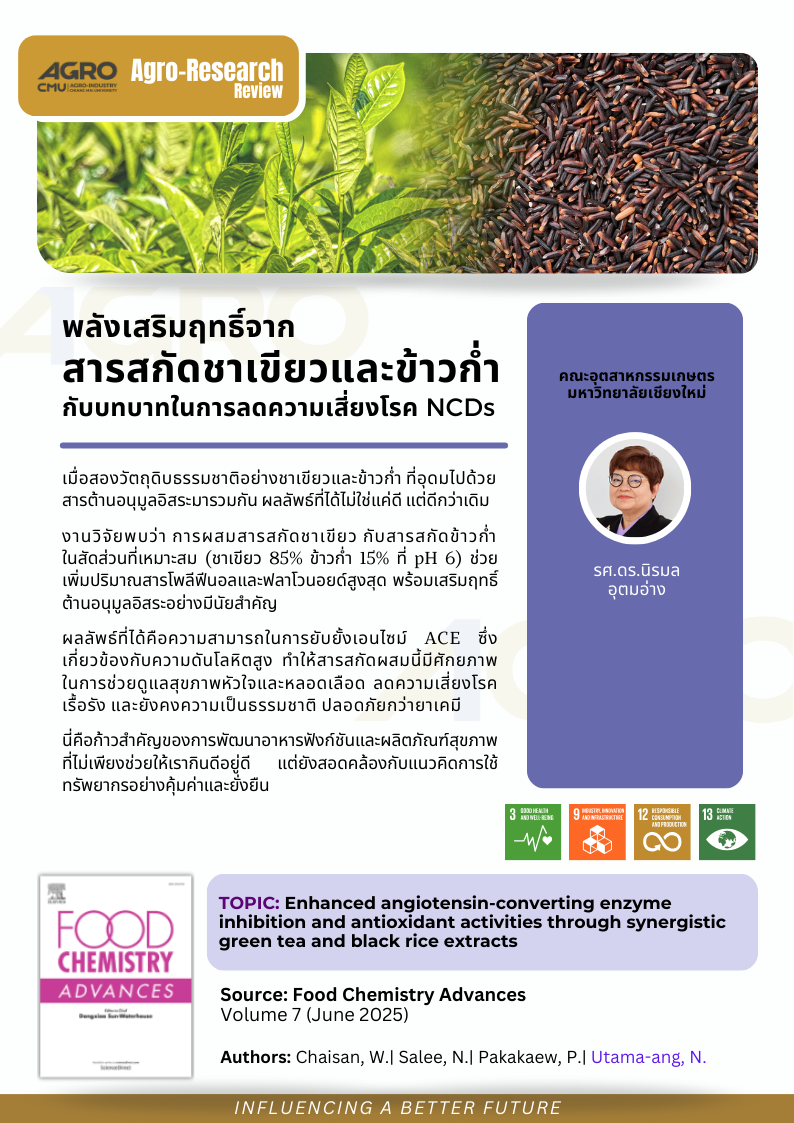
พลังเสริมฤทธิ์จากสารสกัดชาเขียวและข้าวก่ำ กับบทบาทในการลดความเสี่ยงโรค NCDs
เมื่อสองวัตถุดิบธรรมชาติที่อุดมไปด้วยสารต้านอนุมูลอิสระมารวมกัน ผลลัพธ์ที่ได้ไม่ใช่แค่ดี แต่ดีกว่าเดิม งานวิจัยพบว่าการผสมสารสกัดชาเขียวกับสารสกัดข้าวก่ำในสัดส่วนที่เหมาะสม (ชาเขียว 85% ข้าวก่ำ 15% ที่ pH 6) ช่วยเพิ่มปริมาณสารโพลีฟีนอลและฟลาโวนอยด์สูงสุด พร้อมเสริมฤทธิ์ต้านอนุมูลอิสระอย่างมีนัยสำคัญ
ผลลัพธ์ที่ได้คือความสามารถในการยับยั้งเอนไซม์ ACE ซึ่งเกี่ยวข้องกับความดันโลหิตสูง ทำให้สารสกัดผสมนี้มีศักยภาพในการช่วยดูแลสุขภาพหัวใจและหลอดเลือด ลดความเสี่ยงโรคเรื้อรัง และยังคงความเป็นธรรมชาติ ปลอดภัยกว่ายาเคมี นี่คือก้าวสำคัญของการพัฒนาอาหารฟังก์ชันและผลิตภัณฑ์สุขภาพ ที่ไม่เพียงช่วยให้เรากินดีอยู่ดี แต่ยังสอดคล้องกับแนวคิดการใช้ทรัพยากรอย่างคุ้มค่าและยั่งยืน
Synergistic Effects of Green Tea and Black Rice Extracts in Reducing the Risk of Non-Communicable Diseases (NCDs)
When two natural ingredients rich in antioxidants come together, the result isn’t just good—it’s better than ever. Research shows that combining green tea extract with black rice extract in the right ratio (85% green tea, 15% black rice at pH 6) significantly increases polyphenol and flavonoid levels, while boosting antioxidant power.
This synergy also enhances the ability to inhibit ACE, an enzyme linked to high blood pressure. That means this combined extract has the potential to support heart health, reduce chronic disease risk, and remain a safe, natural alternative to chemical drugs. It’s a major step toward developing functional foods and health products that not only help us live well but also align with sustainable resource use.
Topic: Enhanced angiotensin-converting enzyme inhibition and antioxidant activities through synergistic green tea and black rice extracts
Source: Food Chemistry Advances. Volume 7 (June 2025)
Authors: Chaisan, W.| Salee, N.| Pakakaew, P.| Utama-ang, N.
Abstract:
The study investigated the synergistic effects of green tea extract (GTE) and black rice extract (BRE) on total phenolic content, flavonoid content, antioxidant activities and angiotensin-converting enzyme (ACE) inhibition. The influence of GTE concentrations (14.64–85.36 % w/w) and pH levels (3.59–6.41) was analyzed by regression and response surface methodology. Optimized conditions of synergistic effect (85.36 % w/w GTE and 14.64 % of BRE at pH 6.0) yielded the highest antioxidant activities (DPPH IC50 = 0.112±0.015 mg/mL, ABTS = 89.14±1.58 mmol TE/100 g, FRAP = 373.66±3.42 mmol Fe2+/100 g), the highest total phenolic (120.98±1.60 mmol GAE/100 g), flavonoid contents (15.28±1.07 mmol QE/100 g) and ACE inhibitory activity (IC50 = 6.125±0.106 μg/mL). Therefore, this condition was selected to produce the combined extract for determining the combination index (CI). The CI was 0.349±0.075 for DPPH and 0.505±0.019 for ACE inhibition, indicating confirmation of a synergistic effect. These findings suggest that the combined extract could serve as a valuable functional ingredient, enhancing access to bioactive-rich resources for nutritionally supportive and sustainable diets. With potential applications in food systems and healthcare, this agro-ingredient may contribute to improved access to resources for blood pressure management and non-communicable disease (NCDs) prevention, aligning with broader goals in nutrition and health equity.
Keywords: ACE inhibitory activity; Antioxidant activity; Black rice; Green tea; Synergistic effect
View at publisher: https://www.sciencedirect.com/science/article/pii/S2772753X25001091?via%3Dihub
#อกมช. #agrocmu #CMU