

โยเกิร์ตพืชโปรตีนสูง แคลเซียมจากกระดูกปลา เพื่อสุขภาพและสิ่งแวดล้อม
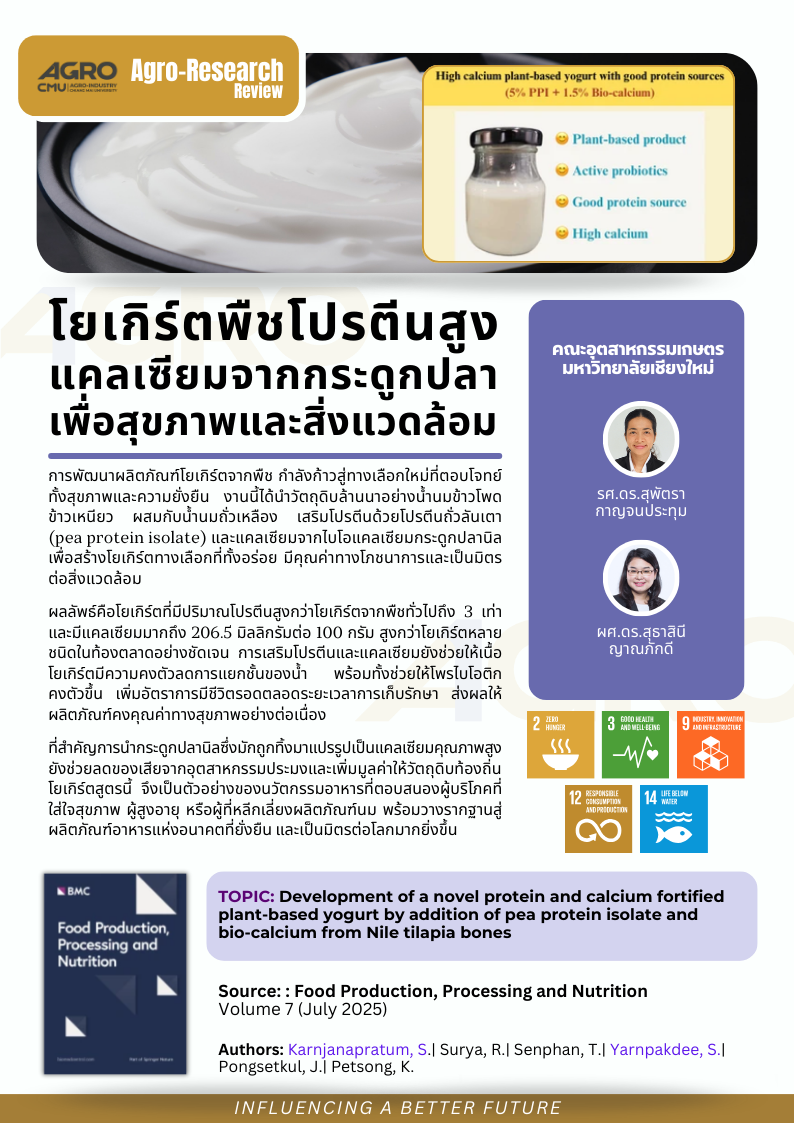
การพัฒนาผลิตภัณฑ์โยเกิร์ตจากพืชกำลังก้าวสู่ทางเลือกใหม่ที่ตอบโจทย์ทั้งสุขภาพและความยั่งยืน งานนี้ได้นำวัตถุดิบล้านนาอย่างน้ำนมข้าวโพดข้าวเหนียวผสมกับน้ำนมถั่วเหลือง เสริมโปรตีนด้วยโปรตีนถั่วลันเตา (pea protein isolate) และแคลเซียมจากไบโอแคลเซียมกระดูกปลานิล เพื่อสร้างโยเกิร์ตทางเลือกที่ทั้งอร่อย มีคุณค่าทางโภชนาการ และเป็นมิตรต่อสิ่งแวดล้อม
ผลลัพธ์คือโยเกิร์ตที่มีปริมาณโปรตีนสูงกว่าโยเกิร์ตจากพืชทั่วไปถึง 3 เท่า และมีแคลเซียมมากถึง 206.5 มิลลิกรัมต่อ 100 กรัม สูงกว่าโยเกิร์ตหลายชนิดในท้องตลาดอย่างชัดเจน การเสริมโปรตีนและแคลเซียมยังช่วยให้เนื้อโยเกิร์ตมีความคงตัว ลดการแยกชั้นของน้ำ พร้อมทั้งช่วยให้โพรไบโอติกคงตัวขึ้น เพิ่มอัตราการมีชีวิตรอดตลอดระยะเวลาการเก็บรักษา ส่งผลให้ผลิตภัณฑ์คงคุณค่าทางสุขภาพอย่างต่อเนื่อง
ที่สำคัญ การนำกระดูกปลานิลซึ่งมักถูกทิ้งมาแปรรูปเป็นแคลเซียมคุณภาพสูง ยังช่วยลดของเสียจากอุตสาหกรรมประมง และเพิ่มมูลค่าให้วัตถุดิบท้องถิ่น โยเกิร์ตสูตรนี้จึงเป็นตัวอย่างของนวัตกรรมอาหารที่ตอบสนองผู้บริโภคที่ใส่ใจสุขภาพ ผู้สูงอายุ หรือผู้ที่หลีกเลี่ยงผลิตภัณฑ์นม พร้อมวางรากฐานสู่ผลิตภัณฑ์อาหารแห่งอนาคตที่ยั่งยืนและเป็นมิตรต่อโลกมากยิ่งขึ้น
--
This plant-based yogurt was developed using Lana local ingredient, waxy corn milk, mixed with soy milk, enriched with pea protein isolate and bio-calcium derived from Nile tilapia bones. The formulation delivers up to three times more protein and 206.5 mg of calcium per 100 g, giving it a significantly higher nutritional value than many common plant-based yogurts. These added nutrients help create a thicker, smoother texture, reduce whey separation, and support better probiotic survival during storage—ensuring long-lasting health benefits.
Importantly, using tilapia bones—normally discarded as waste—to produce high-quality calcium helps reduce environmental impact and adds value to local resources.
This yogurt represents an innovative food solution that supports health-conscious consumers, older adults, and those avoiding dairy products. It also demonstrates how upcycling local materials can lead to sustainable, future-forward food products that are both nutritious and environmentally responsible.
Topic: Development of a novel protein and calcium fortified plant-based yogurt by addition of pea protein isolate and bio-calcium from Nile tilapia bones
Authors: Karnjanapratum, S.| Surya, R.| Senphan, T.| Yarnpakdee, S.| Pongsetkul, J.| Petsong, K.
Abstract: The aim of this study was to develop plant-based yogurt from a mixture of waxy corn and soy milks that mitigated the nutritional deficiencies of typical plant-based products with desirable sensory characteristics and nutritional value by fortifying them with pea protein isolate (PPI) and bio-calcium (Bio-Ca) from Nile tilapia bone. Firstly, different concentrations of PPI (1.0%, 3.0%, and 5.0%) were applied to enhance protein content of plant-based yogurt. Their impacts on the fermentation, physicochemical, and sensory characteristics of developed plant-based yogurts were studied. During fermentation at 40 °C (14 h), the pH of PPI-supplemented samples was higher than that of the control (without PPI) in the first period of fermentation (0–6 h), indicating buffering property of PPI. Titratable acid content (TTA) of yogurt with PPI showed higher TTA than control (p < 0.05) after 14 h of incubation. With good acceptance (score ≥ 6) and high protein content (5.41%), the yogurt with 5% PPI was then selected for a study on Bio-Ca fortification. The results showed that adding Bio-Ca (0.5%, 1.0%, and 1.5%) changed the way yogurt fermented and its physical and chemical properties, especially when Bio-Ca levels were higher than 0.5%. After fermentation, the sample with Bio-Ca exhibited a higher total titratable acidity (TTA) and increased viscosity, indicating enhanced metabolic activity of lactic acid bacteria and the formation of salt bridges, respectively, due to Bio-Ca. Sensory evaluation showed that the addition of Bio-Ca had no adverse effect on all attributes tested. In addition, fortification of Bio-Ca at 1.5% showed that calcium content in yogurt was 206.5 mg/100 g sample. Thus, yogurt with 5.0% PPI and 1.5% Bio-Ca was selected for stability evaluation under cold storage for 21 days. The selected yogurt showed a great stability with > 6 log CFU/mL of probiotics throughout the storage period with a lowered syneresis (78.8%), compared with control (72.0%) (p < 0.05). This study emphasizes a novel formulation of plant-based yogurt, which provides a rich source of protein and calcium, thereby suggesting its potential advantages over both conventional dairy and plant-based yogurts.
Source: Food Production, Processing and Nutrition Vol.7 (July 2025)
Keywords: Plant-based yogurt; Fortification; Pea protein isolate; Bio-calcium; Probiotics; Nutritional value; Storage stability
View at publisher: https://link.springer.com/article/10.1186/s43014-025-00317-0
#อกมช. #agrocmu #CMU